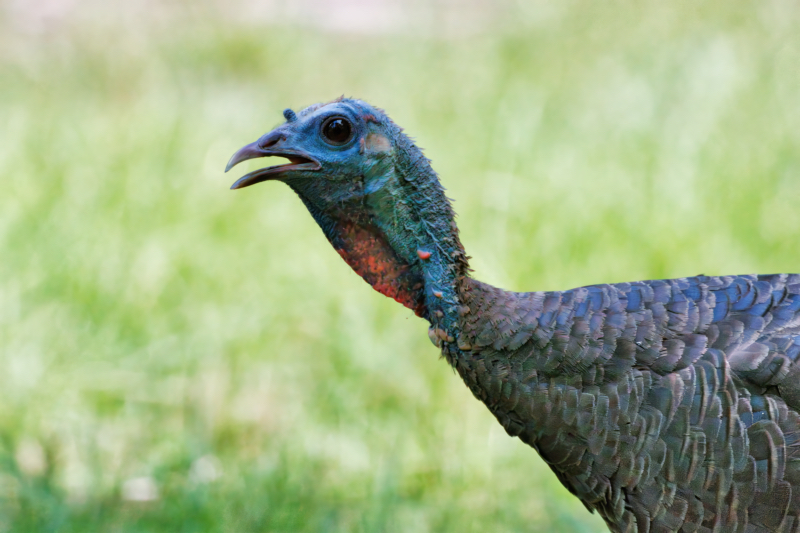
I spent a quiet afternoon in my blind watching a small flock of wild turkey hens work their way into a field near the Ouachita National Forest. Once they stepped out of the timber, they wasted no time and began feeding on the tender young rye grass.
Moments like this remind me why I enjoy photographing wild turkeys so much. Hens often seem calm and deliberate, but they stay alert while they feed, rest, and move through the edge habitat.

Wildlife Notes on Wild Turkey Hens
These hens came into a small field I had planted with winter rye grass near Oden, Arkansas. The field bordered the forest, which gave the birds quick cover and an easy path back into the trees. That mix of open feeding ground and nearby woods often makes a spot like this attractive to wild turkeys.
Wild turkey hens eat a varied diet. They feed on fresh greens, seeds, berries, acorns, and small invertebrates when available. In this case, the young rye grass gave them an easy meal in the middle of the day.
I also noticed that some of the hens paused long enough to take dirt baths (Wild Turkey Taking Dirt Bath). That behavior is always interesting to watch. A dusting spot gives a turkey a place to work through its feathers and settle into the soil for a few minutes before going back to feeding. The hens that day seemed completely relaxed, and they never appeared to notice me in the blind.
Feeding Behavior in the Field
One thing I have seen more than once is how steady hens can be when they find a dependable food source. If the feeding is good, they may return to the same area again. They move, pause, pick, and then drift forward as a group, always covering ground while staying aware of what is around them.
In Arkansas, that can mean feeding in small fields, woodland edges, and openings near the forest. Seasonal foods change, but the pattern stays much the same. Hens spend a lot of time foraging, then stop to preen, rest, or dust before feeding again.

Photography Notes
I photographed this scene from a ground blind, which let me stay hidden while the hens fed at close range. That setup gave me a natural angle and helped me capture behavior without disturbing the birds.
For posts like this, I usually work with my Canon R5 Mark II and either the Canon RF 100-500mm or Canon RF 200-800mm, depending on distance and how much of the habitat I want to include. Soft natural light and a still position matter just as much as the gear. When birds stay relaxed, the photos usually look more natural.
Field details from this encounter:
- Location: Oden, Arkansas
- Date: September 9, 2022
- Time: About 1:30 PM to 1:49 PM
- Exposure Mode: Manual
- Aperture: f/11
- Shutter Speed: 1/800 sec
- ISO: 5000
- Exposure Compensation: +0.3
- Focal Length: 800mm
Final Thoughts
Watching these wild turkey hens feed in that small field gave me a good look at how calm and methodical they can be when conditions feel right. Encounters like this are a big part of why I enjoy spending time in the blind.
Every outing teaches me something. Sometimes it is about behavior, sometimes it is about habitat, and sometimes it is simply a reminder to stay patient and let the scene unfold on its own.
You have some real amazing pictures and stories behind them thank you
Thank you!