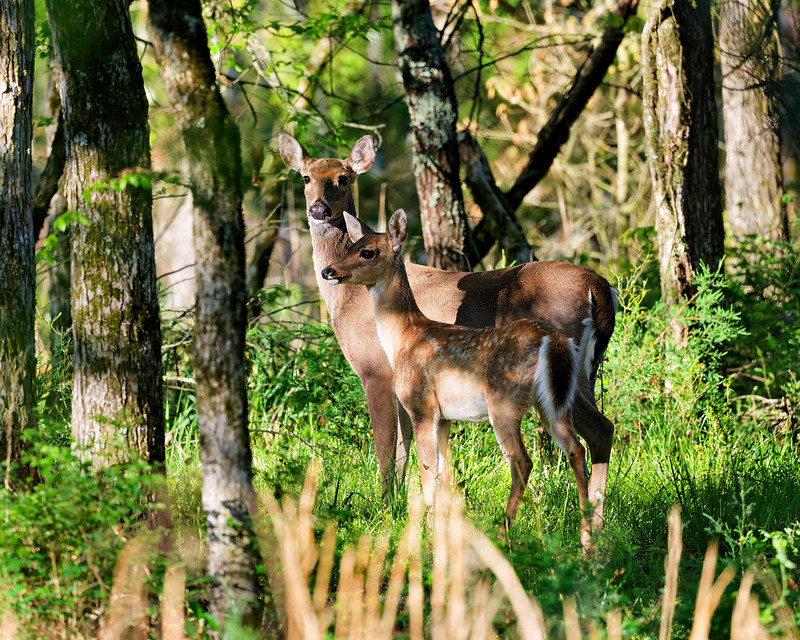
I took a short drive yesterday to the Janet Huckabee Arkansas River Valley Nature Center in Fort Smith, Arkansas. After I got my camera gear together, I started walking one of the trails and almost right away I spotted a White-tailed Doe.
I took a few photos of the doe, then a fawn suddenly stood up beside her. That caught me off guard. Seeing a fawn at this time of year is unusual enough, but this one looked larger and more mature than I expected.
Wildlife Notes
The biggest surprise was the fawn’s appearance. It still showed spots, but it also looked fairly well grown and alert. It did not act like a tiny newborn. It stayed with the doe, looked coordinated, and seemed comfortable moving through the woods.
That is what made this sighting so interesting to me.
In Arkansas, white-tailed deer fawns are typically born in April, May, or June. Fawns also usually lose their spots at around 90 to 120 days, or about 3 to 4 months. Because of that, a spotted fawn in early April does not neatly fit the usual pattern.
My first thought was that this fawn may have been born in the fall or early winter, but that does not fully add up either. If it had been born that early, I would expect the spots to be mostly or fully gone by now. A more cautious explanation is that this may have been a late-born fawn from the previous year, or a young deer whose faint remaining spots were made more obvious by the light. Late fawns do happen, and wildlife agencies note that some fawns can be born well outside the main peak season.
White-tailed Doe and Fawn Behavior
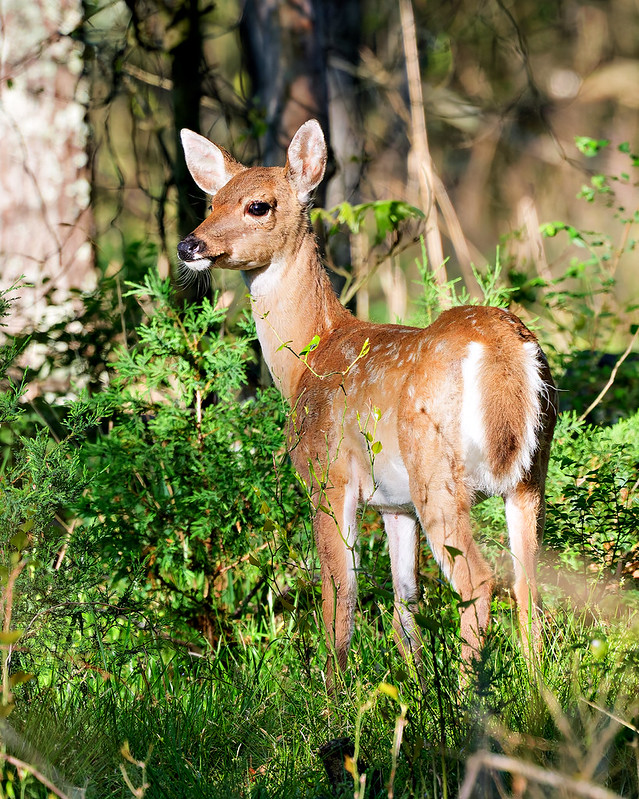
What stood out to me almost as much as the size was the behavior. This fawn stayed close to the doe and looked steady on its feet. Older fawns often move with their mothers, browse on vegetation, and show more awareness and coordination than very young spring fawns. Arkansas Game and Fish also notes that fawns can begin eating vegetation very early and are fully weaned within two to three months.
That does not tell me this fawn’s exact age, but it does help explain why it looked more self-assured than I expected.
The woods also gave this encounter a quiet, hidden feel. The fawn blended in well, even standing up in filtered light. That is a good reminder of how easy it is to miss small deer in the understory, even when they are standing in plain sight.
Photography Notes
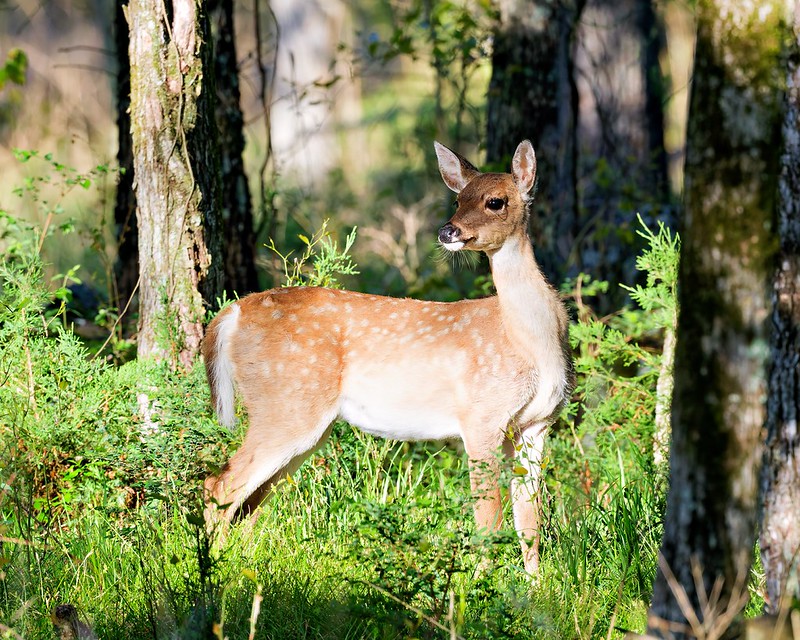
I wish I had better light for these photos, but I still wanted to document the moment. The bright, patchy sun made exposure tricky, especially on the lighter parts of the deer. Even so, this was too unusual for me to pass up.
The image of the fawn by itself became the most useful frame for studying its body size, its faded spotting, and the way it carried itself. The wider frame with both deer works best for telling the story, but the single portrait gives a better look at the young deer’s details.
Camera Setting for Photo 2
- Camera: Canon EOS R5 Mark II
- Lens: Canon RF 100-500mm F4.5-7.1 L IS USM
- Focal length: 500mm
- Aperture: f/8
- Shutter speed: 1/800 second
- ISO: 1250
- Exposure compensation: -1/3
- Support: Hand-held
- Date and Time: April 7, 2026, at 7:18 A.M.
I was hand-holding the RF 100-500mm, which gave me enough reach without being tied down to a tripod. At 500mm and 1/800 second, I had enough shutter speed for a quiet wildlife moment like this, while still keeping the ISO at a workable level in the early morning light. The biggest challenge was the contrast from sun and shade across the deer and the forest floor.
Closing
This was one of those sightings that left me with more questions than answers. That is part of what made it memorable. I went out for a short walk with my camera and ended up photographing a White-tailed Doe with a fawn that did not fit the usual timing I expect to see in western Arkansas.
Even with imperfect light, I am glad I came home with these images. Sometimes the value of a wildlife photograph is not just in the light or the pose. Sometimes it is in documenting a moment that makes you stop, look closer, and think harder about what you are seeing.
Beautiful