The young Eastern Bluebirds nesting in my Arkansas yard gave me a welcome surprise. On July 29, 2026, one chick finally appeared at the birdhouse entrance.
After watching for a while, I thought I could see a second young bird. I cannot confirm the exact number, but at least one nestling is now easy to see.
Young Eastern Bluebirds Appear at the Entrance
I was sitting on my deck photographing the adults as they carried food to the birdhouse. During one visit, a young Bluebird moved into view at the entrance hole.
The chick had developing feathers and a pale yellow gape. It looked alert as it watched the activity outside the box.
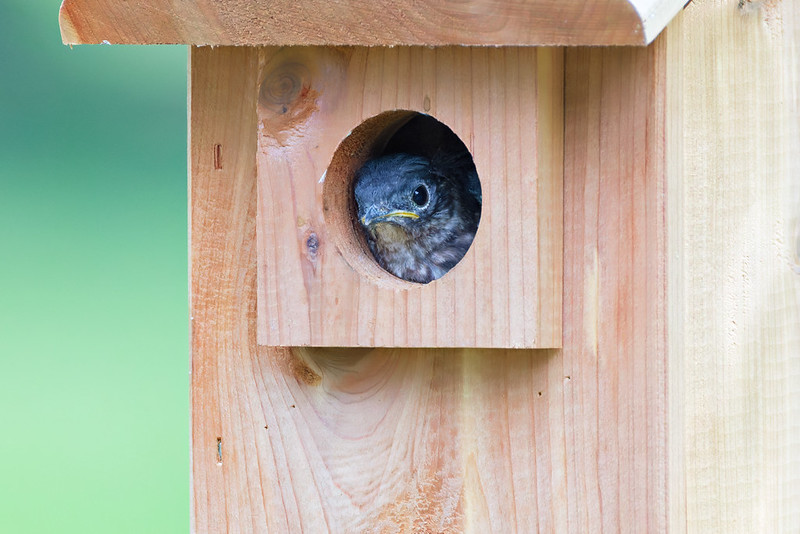
Eastern Bluebirds generally remain in the nest for about 17 to 21 days. That information comes from the Cornell Lab’s Eastern Bluebird nesting guide. Seeing this chick at the entrance makes me think fledging day is getting close.
I believe this is the same pair that nested here earlier this summer. Four young birds left that first nest on June 4. Those juveniles are still nearby and often follow the male while he hunts.
You can see that earlier brood in Baby Bluebirds Fledge From My Arkansas Birdhouse.
This second brood has seemed different from the beginning. At first, I thought the pair might have only one chick because the adults visited less often.
During the first nest, both adults brought food at a rapid pace. This time, I often saw the male arrive two or three times an hour. The female sometimes arrived only once every hour to hour and a half.
Both adults regularly perched at my feeder and ate the mealworms I provided. However, I never saw either bird carry a mealworm to the nest. They appeared to make longer trips elsewhere to find food.
Temperatures above 100 degrees may be affecting their routine. Research reported by Cornell NestWatch shows that extreme heat can create problems for nesting birds, especially insect-eating species such as Bluebirds. Still, I cannot say that heat caused the slower feeding pattern I observed.
The earlier juveniles may also influence activity around the birdhouse. One landed on its roof, and neither parent reacted. First-brood Bluebirds sometimes help feed their younger siblings, according to Audubon, but I have not seen that happen here.
Watching the Birdhouse from My Deck
Most of my photographs are taken from behind the rails on my deck. The Bluebirds are familiar with my presence and do not appear bothered by me.
Both adults will perch nearby while I refill the feeders. They often remain close instead of leaving the yard.
I cannot watch the birdhouse throughout the day. My feeding counts only reflect the periods when I was sitting outside. Even so, the difference from the first nesting has been noticeable.
My last update showed the male carrying food to these chicks during the Arkansas heat. Now I finally have my first look at one of the young birds receiving that food.
A Welcome Look at This Second Brood
Whatever caused the different feeding routine, the visible chick appears alert and well-developed. I was glad to finally see it looking through the entrance.
Fledging should not be far away. I will keep watching from my usual place behind the deck rails while giving the family room to continue its routine.
Beautiful Picture