A Northern Mockingbird without tail feathers has visited my Arkansas yard for the past couple of weeks. It looks strange while perched and even stranger in flight. That long tail normally forms a large part of a mockingbird’s familiar shape.
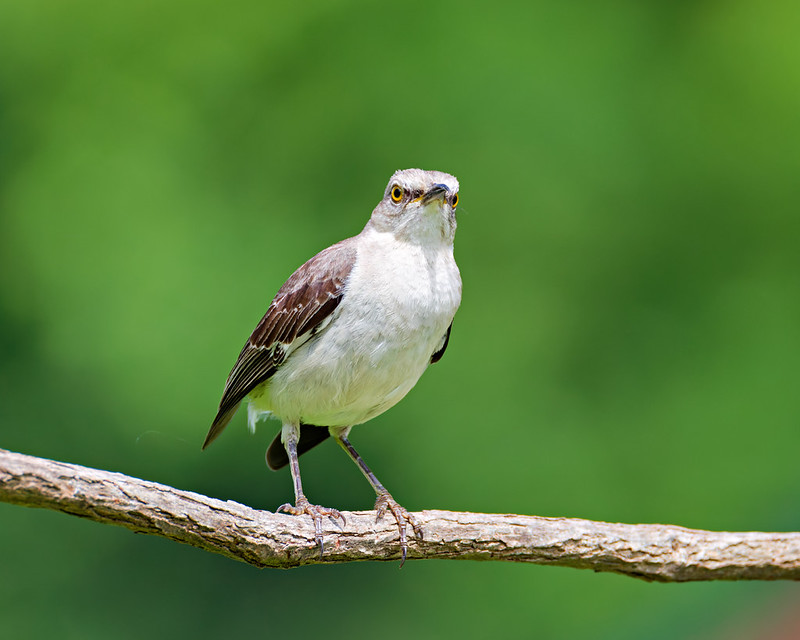
A Northern Mockingbird Without Tail Feathers
The bird appears to have lost nearly all its long tail feathers. It still moves around my yard and can fly, but its outline looks completely different.
Northern Mockingbirds normally have long, rounded tails. Their dark central tail feathers contrast with white outer feathers. Those white feathers become especially noticeable when a mockingbird flies or spreads its tail.
Normal molt does not usually leave a mockingbird completely tailless overnight. Passerines generally replace their tail feathers in a sequence. The process often begins with the central pair and continues outward on both sides.
That balanced pattern helps the bird retain a working tail while new feathers grow. A bird going through normal molt might show gaps or feathers of different lengths. Losing most or all the tail at once suggests that something else may have happened.
Tail Feathers Found in a Fallen Nest
Three days ago, I walked around my property and found a nest lying on the ground. Inside the cup was a clump of feathers that looked like Northern Mockingbird tail feathers.
The feathers stayed attached when I lifted the nest. They did not fall out or scatter. I placed the nest against a pine tree before making the photograph.
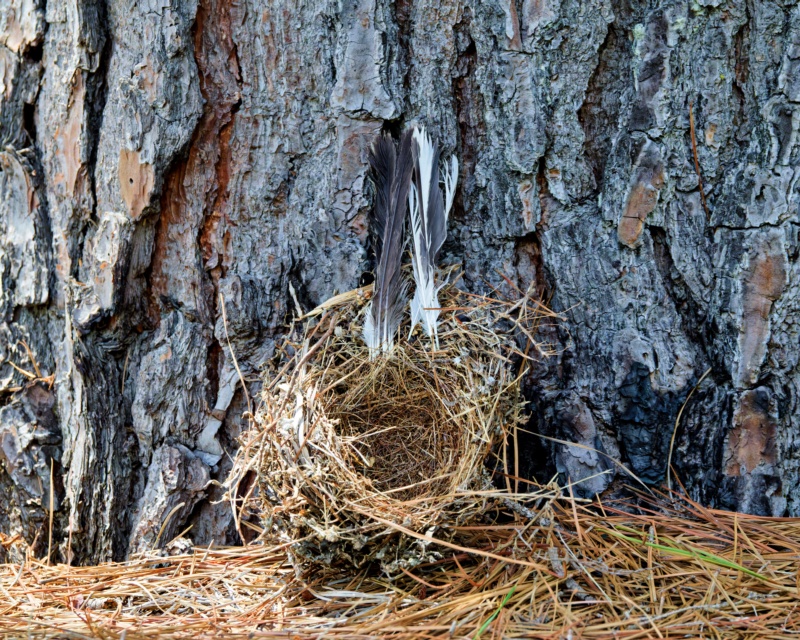
The black-and-white pattern resembles mockingbird tail feathers. Their position in a tight clump makes me wonder if they came out during one event.
However, I cannot prove that these feathers belonged to the tailless mockingbird. I also do not know how they ended up in the nest. The nest and feather clump may be connected to the bird, but that remains my best guess.
A predator encounter is one possibility. A hawk, cat, or another predator could have grabbed the tail while the bird escaped.
Watching for the Mockingbird’s Tail to Return
I have photographed other backyard birds with the same unusual appearance. One was A Tailless American Robin at the Birdbath. Another was A Tailless Tufted Titmouse at Sunrise. Both sightings showed how different a familiar bird can look without its tail feathers.
The encouraging news is that completely lost feathers can begin growing again without waiting for the next regular molt. The Cornell Lab’s guide to feather molt explains that a lost whole feather starts regrowing immediately.
New tail feathers should become more visible as they emerge from the follicles. During that period, the tail may look short or uneven until the feathers reach their full length.
For now, I will keep watching this unusual visitor. If its tail begins returning, that will add another chapter to the mystery. I may never know what caused the loss, but I hope the bird avoided serious harm.
Nice blog, loved it!
Thank you!