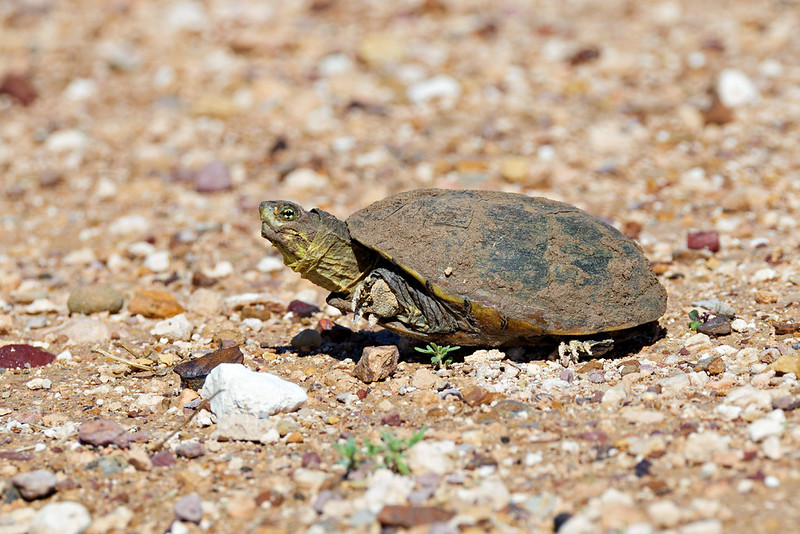
On September 25, 2026, I photographed what I believe is a Yellow Mud Turtle near Black Mesa State Park. It was crossing a dirt road in the Oklahoma Panhandle. My photo shows its yellow throat and a coating of dirt across its shell.
Yellow Mud Turtle Identification and Habitat
The yellow coloring on the throat and the rounded shell support my identification as a Yellow Mud Turtle, Kinosternon flavescens. I am keeping that identification tentative because this photograph provides only one view.
These small turtles live across western Oklahoma. They use farm ponds, temporary pools, shallow wetlands, and streams with soft bottoms. Adults commonly reach about five inches in shell length.
Their shell can look yellowish-brown, while the head and neck have a yellow tint. In my photograph, the yellow beneath the head stands out against the dusty shell.
Closer to home in Arkansas, I photograph another species, the Mississippi Mud Turtle. This Black Mesa encounter gave me a chance to compare the turtle in my photo with those I see near home.
Yellow Mud Turtles eat both animal and plant material. Their diet includes insects, crayfish, tadpoles, and aquatic plants. They can forage in water and on land, which helps explain why an aquatic turtle might turn up away from water.
Photographing the Yellow Mud Turtle on the Dirt Road
I used my Canon EOS R5 Mark II and RF 200–800mm lens for this photograph. At 637mm, I framed the turtle with enough of the road to show the stones and dirt around it.
The side view gives a clear look at the head, neck, and outline of the shell. One front foot lifts above the road. I like that detail because it shows the turtle in the act of walking.
My settings were:
- Camera: Canon EOS R5 Mark II
- Lens: Canon RF 200–800mm F6.3–9 IS USM
- Aperture: f/10
- Focal length: 637mm
- Shutter speed: 1/2000 second
- ISO: 400
Life Between Water and Dry Ground
Yellow Mud Turtles travel overland and can move into isolated ponds. They also spend long periods buried in soil away from their feeding waters. Temporary ponds and nearby ground suitable for burrowing are important parts of their habitat.
I cannot say where this turtle was headed or why it crossed the road that September day. Its presence on dry ground fits the species’ known habits, though.
This encounter gave me a chance to photograph a turtle in the Black Mesa area and learn about its life. I came away with a better appreciation for the land these turtles use between visits to water.