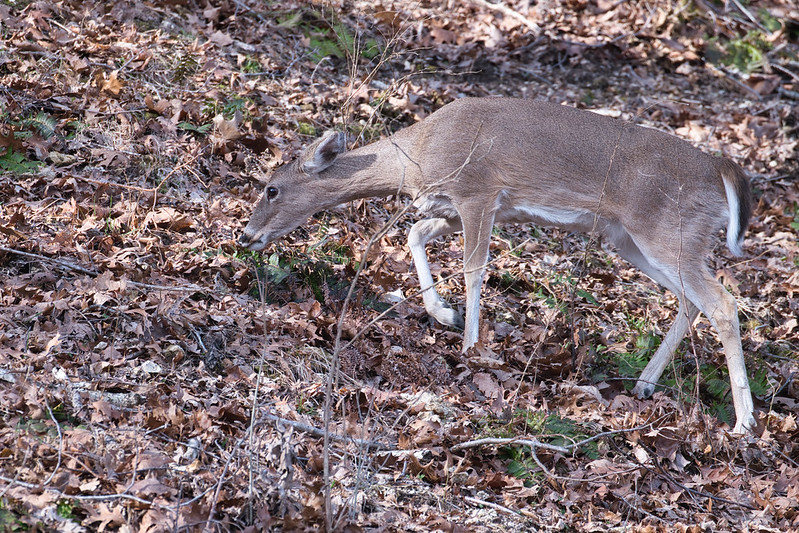
I spotted this whitetail doe crossing the county road at J.T. Nickel Family Nature and Wildlife Preserve in Oklahoma. She had just left a nearby field with several other deer and was heading up an oak ridge to feed before bedding down for the day.
Wildlife Notes: Whitetail Doe Feeding Behavior
Whitetail does often feed heavily in the morning before moving to bedding areas. This doe was browsing on acorns and other vegetation on the ridge. Oak ridges provide excellent food sources for deer, especially in late winter when acorns from the previous fall are still available.
The doe showed typical alert behavior while feeding. She would lower her head to browse, then raise it to scan for threats. Her ears rotated independently to pick up sounds from different directions. This feeding pattern, browse and watch, is how deer stay safe while foraging in open areas.
I watched her cross the road from a nearby field. Several deer had left the field together, but this doe separated from the group to feed on the ridge. Deer often split up after leaving feeding areas, each choosing their own route to daytime bedding sites.
Photography Notes: Photographing Deer from a Vehicle
I photographed this doe from my pickup using a Fujifilm X-T3 camera and a Canon EF 100-400mm f/4.5-5.6L IS II lens attached with a Fringer EF-FX Pro adapter. The camera and lens rested on a bean bag draped over the open window. This setup provides solid support and lets me make small adjustments quickly.
I had just finished photographing a different whitetail doe on the south side of the county road. When I drove a few yards forward, I spotted this doe crossing to the ridge. I stopped immediately and set up for the shot.
The doe was at 400mm focal length. I used aperture priority mode at f/5.6 to keep the shutter speed high enough for a sharp image. ISO 800 gave me a shutter speed of 1/480 second, which was plenty fast to freeze any movement.
Vehicle photography works well for deer because they often ignore parked vehicles. The pickup acts as a blind. I keep movements inside the cab slow and deliberate. Opening the window before the deer gets close helps avoid spooking them with sudden motion.
Camera Settings
- Support: Bean bag on vehicle window
- Camera: Canon R5 Mark II
- Lens: Canon RF 100-500mm f/4.5-7.1L IS USM
- Mode: Aperture Priority (Av)
- Aperture: f/5.6
- ISO: 800
- Shutter Speed: 1/480 sec
- Focal Length: 400mm
The morning light was soft when I photographed this doe. The overcast sky acted as a natural diffuser, eliminating harsh shadows on her face and body. The ridge habitat behind her shows the type of terrain whitetails prefer for daytime cover.
J.T. Nickel Preserve offers excellent opportunities for photographing deer and other wildlife. The county roads that run through the preserve let photographers position vehicles near active feeding and travel routes.
More photos from J.T. Nickel Family Nature and Wildlife Preserve: This Whitetail Buck Has Shed Both Antlers and J.T. Nickel Family Nature and Wildlife Preserve