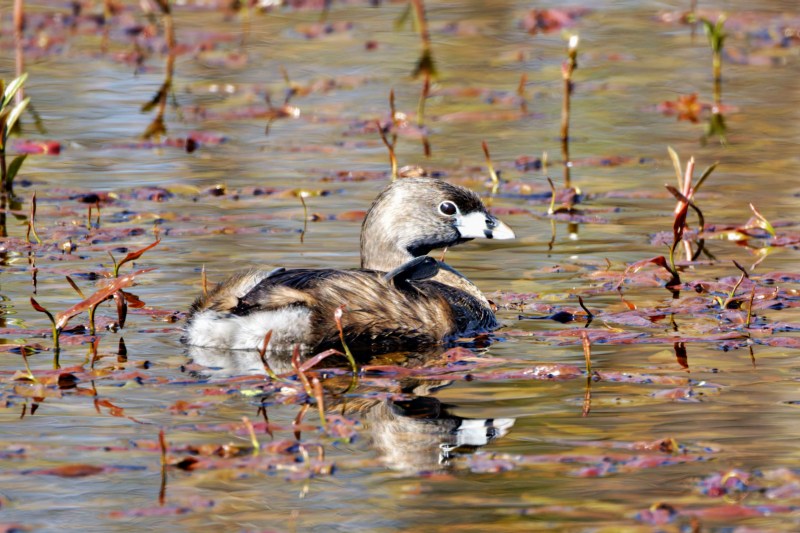
I photographed this Pied-billed Grebe during a quiet morning at Sequoyah National Wildlife Refuge. What caught my eye was the odd dark bump on its back, a foot resting out of the water in a behavior often called foot-shipping.
Wildlife Notes on Pied-billed Grebe Foot-shipping
Pied-billed Grebes spend much of their time low in the water, where even small movements can be easy to miss. In this frame, the bird looks calm and settled, but one foot is lifted up onto its back instead of trailing underwater.
That posture is often described as foot-shipping. In general terms, birds that sit in cool water can reduce heat loss by pulling a foot out of the water for a while.
What I like about this moment is how easy it would be to overlook. At first glance, the grebe seems to be doing almost nothing. Then you notice the foot tucked up on the back, and the whole image tells a more interesting story.
A few days before this sighting, I shared another post about a different puzzling grebe pose. That earlier moment makes a nice companion to this one because both photos show how these birds can look ordinary one second and completely quirky the next. Related post: Pied-billed Grebe Stretching
Photography Notes
I made this photo on March 20, 2024, at 10:16 A.M. from my truck using a bean bag draped over the window for support. That setup gave me a steady rest and let me stay low and quiet while I watched the grebe.
Camera Settings
- Camera: Canon EOS R7
- Lens: Canon RF 800mm F11 IS STM
- Focal length: 800 mm
- Aperture: f/11
- Shutter speed: 1/1600
- ISO: 1600
- Exposure compensation: -1/3
- Support: Bean bag draped over truck window
- Date and Time: March 20, 2024, 10:16 A.M.
The 800mm focal length helped me fill the frame without pushing too close. That matters with a bird like this because the behavior is subtle, and a tight composition makes the foot stand out more clearly.
I also like this kind of support for refuge road shooting. A bean bag is simple, stable, and fast to adjust when the bird changes position. With the shutter at 1/1600, I had enough speed to hold detail while keeping the setup practical from the vehicle.
Final Thoughts
I enjoy photographs like this because they ask the viewer to slow down. What looks ordinary at first can turn into a small lesson in bird behavior, and that is part of what keeps me coming back to places like Sequoyah National Wildlife Refuge.
Steve,
Really beautiful picture, but I can’t quite see the “foot – shipping”.
Anyway you can help?
Thx!
Sue
Look to the right of its back straight below its eye. The black spot is its foot. Here is a larger photo: https://flic.kr/p/2pFBz3d