I spotted this Remote Automated Weather Station on the edge of a field at Sequoyah National Wildlife Refuge in Oklahoma. At first, I had no idea what it was.
It looked out of place enough that I stopped and made a photo. Later, I did an online search and found out it was a weather station.
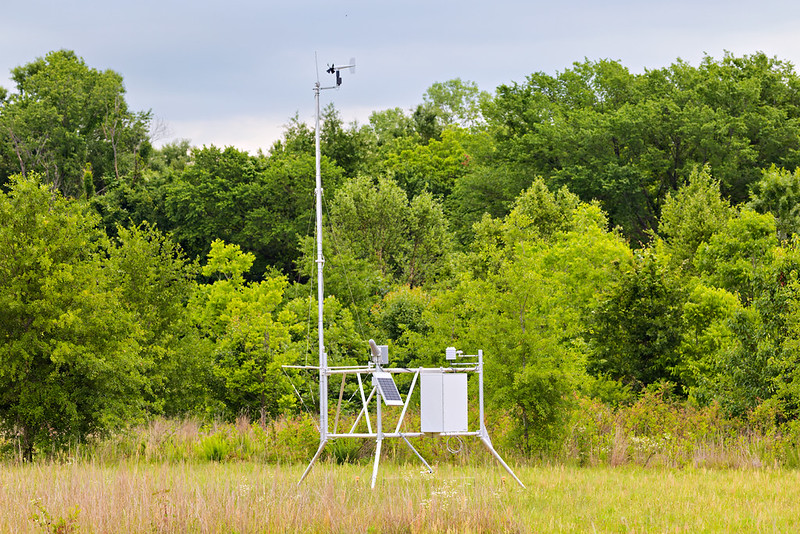
Remote Automated Weather Station on the Field Edge
This station was sitting near a grassy field with thick green trees behind it. The overcast sky gave the whole scene a quiet look.
Stations like this are often used in remote areas to collect weather information. The National Interagency Fire Center says RAWS units are placed in remote locations across the United States and several U.S. territories.
The one I photographed had a tower, solar panel, antenna, and equipment box. Those parts helped me figure out that it was not just a random utility setup.
Why This Remote Automated Weather Station Caught My Attention
I spend a lot of time watching for wildlife at Sequoyah National Wildlife Refuge. Most of the time, I am looking for birds, mammals, reptiles, or anything moving through the habitat.
This was different. It was a piece of equipment, but it was still part of the refuge landscape.
It also reminded me of another refuge equipment post I wrote about a propane cannon at the refuge. Both subjects caught my attention because I did not fully understand what I was seeing at first.
These stations collect local weather data. Wildfire.gov says RAWS units collect, store, and forward weather data to the National Interagency Fire Center in Boise, Idaho.
That makes sense for a place with fields, wetlands, timber, and changing weather. Local conditions can matter a lot on a refuge.
Photographing the Station in Overcast Light
I photographed this from a distance with my Canon RF 200-800mm lens. I used the long lens to frame the station without walking into the field.
The light was soft because of the cloud cover. That helped keep the white frame and equipment box from looking too harsh.
Camera settings:
- Camera: Canon EOS R5 Mark 2
- Lens: Canon RF 200-800mm F6.3-9 IS USM
- Focal length: 145 mm
- Aperture: f/8
- Shutter speed: 1/1000 second
- ISO: 1000
- Exposure compensation: 0
- Support: Hand-held
- Date and time: May 13, 2026, at 09:03 A.M.
This was not the kind of subject I expected to photograph that morning. Still, it caught my attention because it showed another working piece of the refuge.
Sometimes a photo helps me learn what I am looking at.