I was walking the maintenance road between Lower and Upper Scarborough at the Sequoyah National Wildlife Refuge in Oklahoma when a small, fast bird came low over my head. I never got my camera on it before it slipped behind a tree, so I stayed focused on that spot and waited.
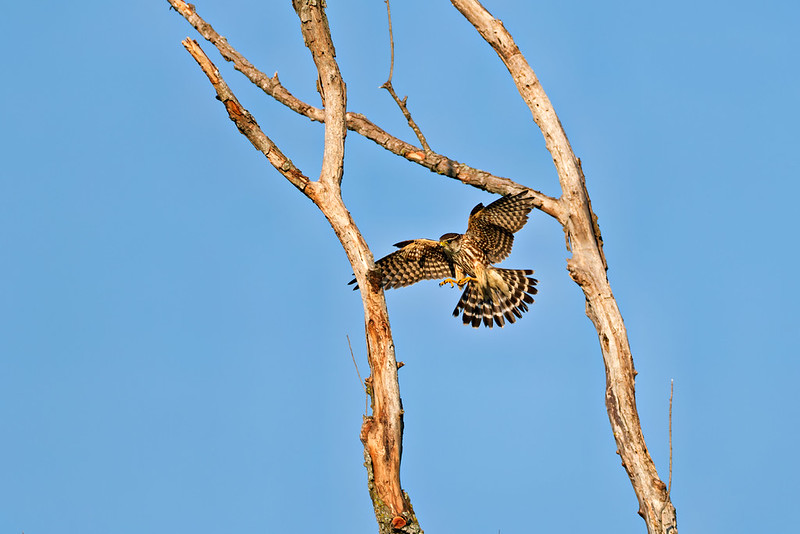
It landed. And that’s when I got my first-ever look at a Merlin.
Wildlife Notes on a Merlin at Sequoyah
I did not know what this bird was when I photographed it. Later, I sent one of the photos to my friend Mia at On The Wing Photography, and she identified it as a Merlin.
The Merlin is a small falcon. It is compact, fast, and built for quick pursuit. They often hunt smaller birds and use open areas, field edges, and tall perches to watch what is happening around them. A dead tree like this one makes a good lookout.
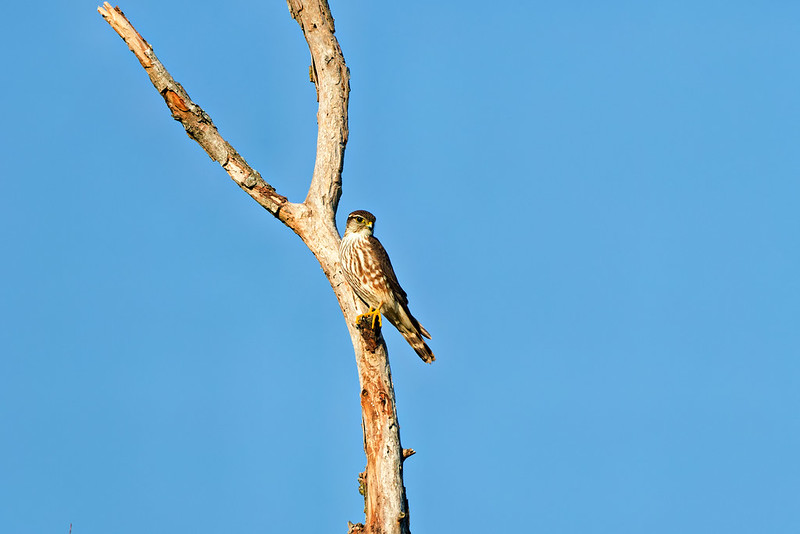
In my photos, the bird used the snag exactly that way. It came in low, then landed high where it had a clear view. That fit the behavior of a bird that wants a strong perch and open sight lines.
March 30 is a reasonable date to encounter a Merlin at Sequoyah. The species winters across the southern United States and migrates north through the region in spring. This bird was likely moving through, using the refuge’s open areas and dead snags as a brief resting stop. That tracks with what I saw. It landed, scanned the area from the top of a large dead tree, and eventually moved on.
Photography Notes for The Merlin at Sequoyah
This happened fast. I had no chance to photograph the bird as it first came over me because it passed low and went behind a tree. Once I saw it was heading for the dead snag, things changed. I had a fixed point, and that gave me a real shot.
The dead tree helped the photo as much as the bird did. The pale wood stood out against the blue sky, and it gave the Merlin a clean place to land and perch. The first frame, with the wings spread, tells the story of the encounter. The second frame gives a better look at the bird once it settled in.
I was hand-holding the Canon RF 200-800mm, which gave me the reach I needed. Once the Merlin perched, the ISO was good, so I raised my shutter speed in case it took flight again. That gave me a little more room to be ready for any quick movement.
Camera settings
- Camera: Canon EOS R5 Mark II
- Lens: Canon RF 200-800mm F6.3-9 IS USM
- Focal length: 800mm
- Aperture: f/10
- Shutter speed: 1/1000 second and 1/3200 second
- ISO: 1600 and 320
- Exposure compensation: +1/3
- Support: Hand-held
- Date and time: March 30, 2026, 8:45 a.m.
My First Merlin at Sequoyah Was One to Remember
I always like photographing a species for the first time, especially when the whole encounter happens in just a few seconds. This Merlin gave me that kind of moment.
I missed the first pass, stayed with the bird, and got another chance when it landed. That second chance turned into my first Merlin photos, and that made this stop on the refuge road worth every step.
For more of what this refuge has to offer year-round, see my post on why I photograph at Sequoyah National Wildlife Refuge. And if you’re curious about the other small falcons I’ve photographed here, my American Kestrel with wings spread post shows how different the two species look in a similar pose.
There are so many birds out there I have never heard , nor seen… Thanks Steve, I learn so much from your posts!
Totally agree. Thank you Steve!