On a February morning at Sequoyah National Wildlife Refuge in Oklahoma, I watched a male Red-winged Blackbird perched on a dry corn stalk, holding a kernel of corn in its beak. The bird stayed balanced on the narrow stalk, gripping it tightly with its feet while it worked the kernel into position to swallow.
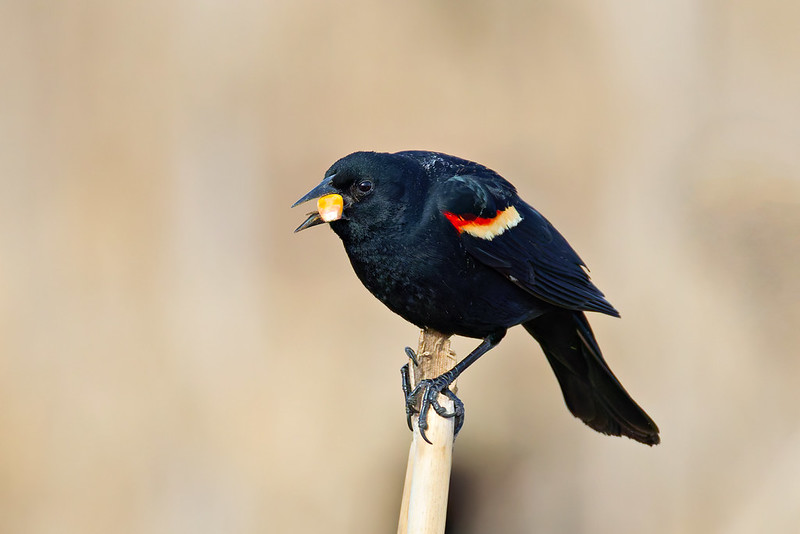
This moment lasted only a few seconds. The blackbird tilted its head back, adjusted the kernel, and swallowed it whole. Afterward, it remained on the same stalk, scanning the field below for more food.
This is a common winter behavior at the refuge. When cornfields are knocked down or harvested, Red-winged Blackbirds feed directly from the remaining stalks and scattered kernels.
Red-winged Blackbird Feeding Behavior
Other male Red-winged Blackbirds were feeding on nearby corn stalks at the same time, each working individual kernels from the dry plants.
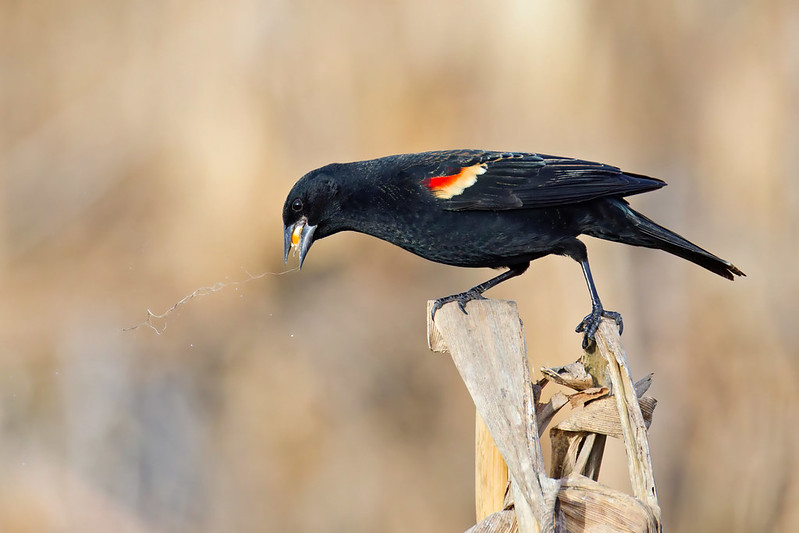
Red-winged Blackbirds depend heavily on grain during the winter months. Corn provides an easy and reliable food source, especially in agricultural areas and managed wildlife refuges like Sequoyah.
Male Red-winged Blackbirds are easy to recognize by their glossy black feathers and bright red shoulder patches edged in yellow. In winter, they often gather in large flocks with other blackbirds, grackles, and starlings.
Seeing individual male Red-winged Blackbirds perched on corn stalks with food in their beaks gives a clear look at how they feed.
This also shows how adaptable they are. They move easily between wetlands, marsh edges, and open agricultural fields depending on what food is available.
I have photographed these birds at this refuge for many years, and their behavior is always worth watching. In another post, I shared more about their personality and behavior in Red-winged Blackbird: The Showoff of the Wetlands.
Photography Notes
I photographed this male Red-winged Blackbird from my truck while driving the auto tour road. Shooting from the vehicle allows me to get closer without disturbing the bird.
The corn stalk made a clean and natural perch. It also helped isolate the subject against a soft background.
Using a long focal length allowed me to fill the frame without moving closer and risking flushing the bird.
Because the bird was actively feeding, I kept my shutter speed high to freeze the moment as it handled the kernel.
Camera Settings
- Camera: Canon EOS R5 Mark II
- Lens: Canon RF 200–800mm F6.3–9 IS USM
- Focal Length: 800mm
- Aperture: f/10
- Shutter Speed: 1/3200 second
- ISO: 2500 (first image), 3200 (second image) and 1250 (third image)
- Exposure Compensation: 0
- Date Taken: February 11, 2026
- Location: Sequoyah National Wildlife Refuge, Oklahoma
Why I Photograph Red-winged Blackbirds
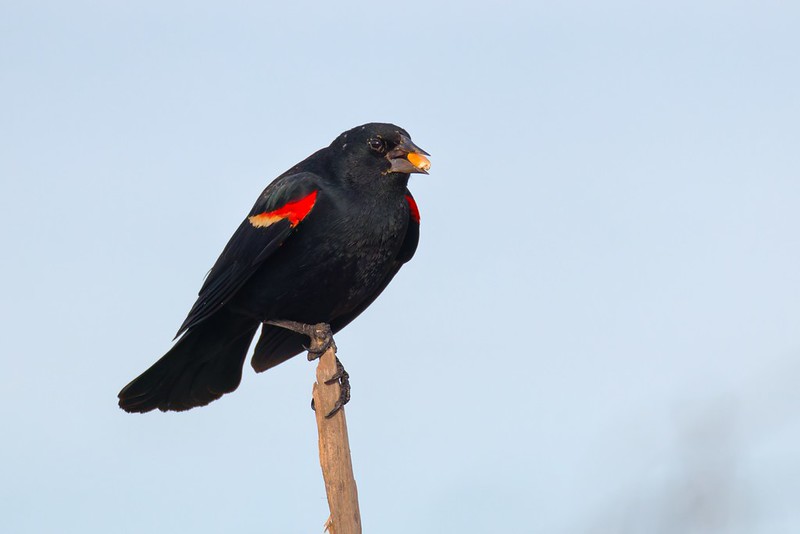
Red-winged Blackbirds are one of the most common birds at Sequoyah National Wildlife Refuge, but moments like this make each encounter unique.
Photographing them while feeding tells more of their story. It shows not just what they look like, but how they survive and use their environment.
A simple corn stalk became both a perch and a food source. These small details are what I look for when photographing wildlife.
They help tell the full story of the moment.