One of the two young Eastern Bluebirds has returned to the feeders in my Arkansas yard. On August 13, I photographed a juvenile Bluebird feeding with help from an adult male.
Two weeks had passed since this young bird left the birdhouse.
Juvenile Bluebird Feeding Two Weeks Later
The two chicks left my birdhouse on July 30. I watched both make their first flights and saw the adults feeding them afterward.
For the next two weeks, I saw the fledglings at a distance around my property. They have started coming closer to the house.
Both young birds visit the area around my feeders for mealworms. I have also watched them use the birdbath.
The juvenile in this photo still has the spotted breast and pale gape of a young Eastern Bluebird. An adult male brought it mealworms while both birds stood on the same perch.
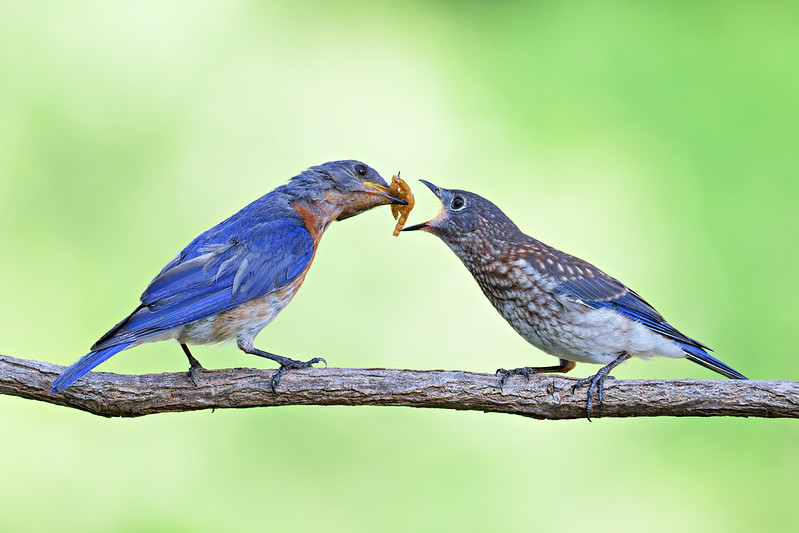
The juvenile opened its bill as the adult held out the food. I pressed the shutter with the mealworms between the two birds.
The Georgia Department of Natural Resources notes that adults may feed their young for up to a month after fledging. This bird was two weeks out of the nest, so I expected some dependence on its parents.
The juvenile also travels between the feeders and birdbath. These visits give me a closer look at its life after leaving the nest.
Photographing Both Birds on One Perch
I photographed the pair on a branch near my feeders. The open space around the perch gave me a clear view of both birds.
Their positions made the feeding behavior easy to see. The adult male leaned toward the juvenile while the young bird begged with its bill open.
A clean green background kept attention on the Bluebirds and the mealworm. Both birds also faced each other, which made the interaction stand out.
The juvenile’s spotted plumage matched the fledglings I watched leave two weeks earlier. Its blue wing and tail feathers have also become more noticeable.
Watching the Fledglings Return
I wrote about their departure in Second Bluebird Brood Fledges From My Arkansas Birdhouse. Both young birds left within minutes, and their parents found them after they flew.
Since then, the family has remained in my yard. The fledglings stayed farther away at first, often hidden by leaves or distance.
Their visits to the feeders give me more chances to follow their progress. The adults still provide food while the young birds spend time around the mealworms and birdbath.
I plan to keep watching as the juveniles become less dependent on their parents. Seeing this one accept a mealworm gave me another update on the Bluebird family’s summer.
Been trying to find a good “Live mealworm feeder” suggestions?
I use this and add sunflower seeds on one side and mealworms on the other: Metal Mesh Seed Tray https://a.co/d/0cyBVffs