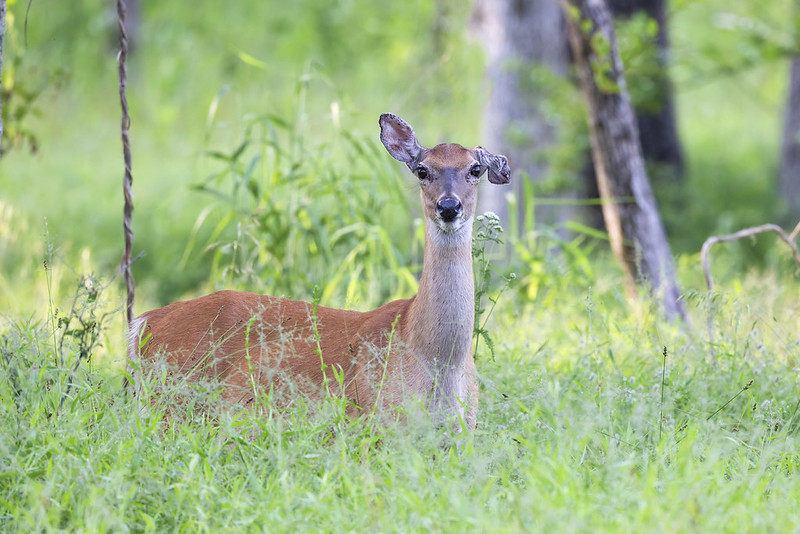
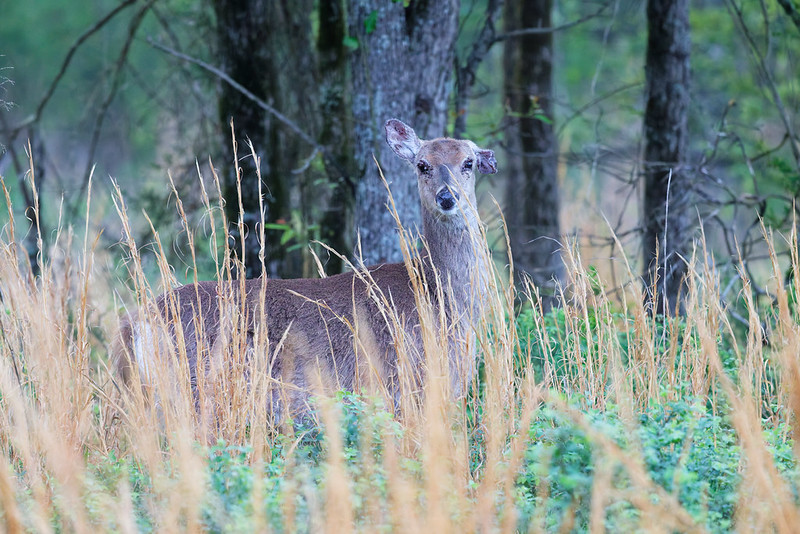
I photographed this doe with injured ear damage at the Janet Huckabee Arkansas River Valley Nature Center in Fort Smith, Arkansas, nearly three years apart. Both photos were taken near the exact same spot along one of the trails. What stood out most was seeing that same ear injury again, along with what looks like a heavier tick load around her eyes and ears in 2026.
Doe With Injured Ear Seen Again Near the Same Spot
The first photo was taken on May 30, 2023. The second was taken on April 8, 2026. Seeing what appears to be the same doe again after almost three years was interesting by itself, but finding her near the same spot made the comparison even stronger.
The injured ear is the detail that ties these two encounters together for me. Her face shape and overall look seem consistent too, but that ear is the feature that stands out first. It gives me the clearest visual marker when I look at the two photos side by side.
The setting changed between the two encounters, even though the location was nearly the same. In the 2023 photo, she was standing in greener spring cover with a softer look to the scene. In the 2026 photo, she was standing in taller, drier grass with darker woods behind her. Even with those changes, the damaged ear still stands out right away.
I first shared the 2023 image in an earlier post, Survivors, Injured White-Tailed Does. Seeing what appears to be the same deer again gave that earlier post even more meaning for me.
Comparing the Ear Injury and Tick Load
The biggest difference I noticed between the two photos was the number of ticks visible around the doe’s ears and eyes. In the 2023 image, they are already easy to see. In the 2026 image, they appear more concentrated around her face, especially near the eyes and ears.
I do not know how long she had that ear injury before I first photographed her in 2023. I also do not know how old she was at that time. What I can say is that the same damaged ear was still visible when I photographed her again in 2026.
That is what makes this comparison interesting to me. It is more than two deer photos taken years apart. It is a look at what appears to be the same individual over time, with one clear identifying feature unchanged and a more noticeable tick problem in the newer image.
Photographing This Fort Smith Deer on the Trail
I photographed both images while walking one of the trails at the nature center. I was hand-holding my camera, which gave me the freedom to react quickly when I saw her. With deer, that matters because a short delay can be the difference between a calm pose and a deer that slips away.
The second photo was made early in the morning, and the light was limited enough to push the ISO high. I still wanted enough shutter speed to support hand-held shooting at 500mm while keeping the image sharp. The doe stayed in place long enough for me to make the frame.
Camera settings for the second photo:
- Camera: Canon EOS R5 Mark II
- Lens: Canon RF 100-500mm F4.5-7.1 L IS USM
- Focal length: 500 mm
- Aperture: f/8
- Shutter speed: 1/250
- ISO: 8000
- Exposure compensation: 0
- Support: Hand-held
- Date and Time: April 08, 2026, 07:16 A.M.
It is not often that I get a chance to compare what appears to be the same doe across nearly three years. Finding her again near the same spot, with the same injured ear, made this feel like more than a single wildlife sighting.