I was walking a gravel road toward War Eagle Creek near Witter, Arkansas when I spotted this White-lined Sphinx Moth. I had my camera with me, and I managed to get a shot before it moved on.
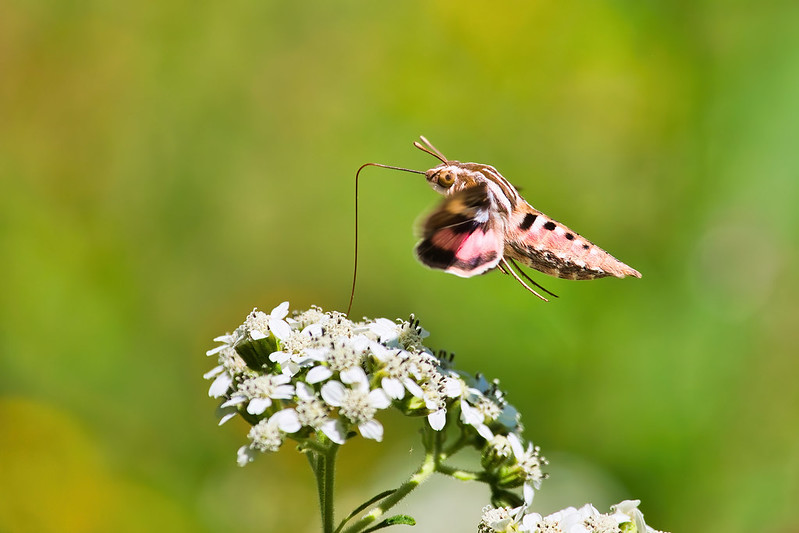
Wildlife Notes: White-lined Sphinx Moth
The White-lined Sphinx Moth (Hyles lineata) is one of the more striking insects you can run into across North America. Adults are large, with a wingspan that can reach around three inches. The wings and body are patterned in bold stripes of black, white, and pink. Once you know the look, you will not mistake it for anything else.
These moths are fast and agile fliers. Adults hover in front of flowers and use a long, coiled proboscis to feed on nectar. The behavior looks very similar to a hummingbird, which is why people sometimes call them hummingbird moths. They are active during the day as well as at dusk and dawn, which is a little unusual for moths.
The larvae are polyphagous, meaning they feed on a wide range of plants. Common host plants include grape, apple, evening primrose, and various garden plants. The caterpillars can vary quite a bit in color, from green to nearly black, often with yellow spots or a striped pattern.
I found this individual in September, which falls toward the later end of the flight season in Arkansas. Adults are generally seen from spring through fall depending on the region.
Photography Notes: Handheld at Midday
I was hand-holding my camera when I took this photo, which is not always ideal for insect work but it paid off here. A fast shutter speed helped compensate for both the moth’s movement and any camera shake from shooting handheld.
Gear Used:
- Camera: Canon EOS 1D Mark III
- Lens: Canon EF 100-400 mm f/4.5-5.6 L USM
Technical:
- Location: War Eagle Creek (Arkansas)
- Date & Time Taken: September 11, 2011 (12:13:20 P.M.)
- Aperture Priority
- Aperture: f5.6
- Shutter speed: 1/2000 sec. (as determined by the camera)
- ISO: 400
- Exposure Compensation: 0 EV
- Focal Length: 400 mm
Midday light in September is bright and a little harsh, but at 1/2000 sec I was able to freeze the subject cleanly. Shooting at 400mm compressed the background nicely and kept the moth isolated.
Related Posts
If you enjoy moth and insect photography, you might also like these posts: