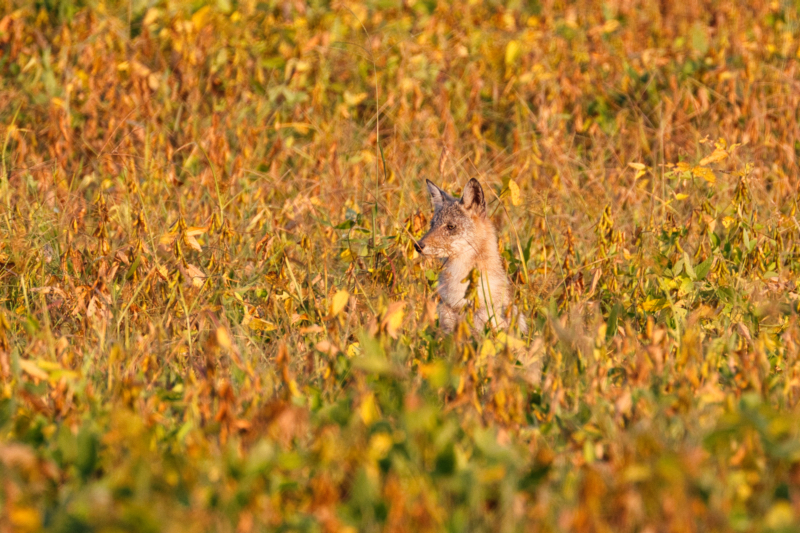
I spotted a young coyote sitting in tall grass near Dockery Field at Sequoyah National Wildlife Refuge in Oklahoma. The canid was locked onto a flock of birds feeding nearby, every muscle tense and ready. I pulled over immediately to watch this hunt unfold.
Watching a Patient Predator
The coyote stayed sitting in the grass for over ten minutes. I could see its ears tracking the birds’ movements even when its head didn’t move. This wasn’t the frantic chase I’d seen from adult coyotes before. This was calculated waiting.
The birds stayed just out of range. Every time they moved closer, the coyote’s body tensed slightly, ready to spring. When the birds finally flew off, the young hunter slipped into the brush without a meal.
Wildlife Notes: Young Coyote Hunting Behavior
This coyote showed the hallmark signs of a young animal still learning to hunt. Its coat had that lighter, fluffier appearance typical of juveniles in their first year. The patient sit-and-wait technique was there, but the timing and distance judgment that comes with experience wasn’t quite dialed in yet.
Young coyotes often hunt alone during their first autumn after leaving the den. September in Oklahoma marks the time when these animals start developing the skills they’ll need to survive winter. Birds make good practice targets because they’re abundant and the stakes are lower than tackling larger prey.
The tall grass habitat near Dockery Field is ideal for this kind of ambush hunting. Coyotes in open refuge areas learn to use every bit of cover available. This one had positioned itself downwind of the birds, showing good instinct even if the execution fell short.
Early morning hunts are prime time for coyotes at Sequoyah. Prey animals are most active at dawn, and the cooler temperatures let coyotes move and hunt without overheating in their thick coats.
Photography Notes: Shooting from the Truck
I set up with my bean bag draped over the truck’s open window. This gave me a stable platform without having to exit the vehicle and spook the coyote. The refuge allows roadside photography, and staying in your vehicle is often the best way to get close to wary predators.
I was shooting with my Canon EOS 7D Mark II and Canon EF 100-400mm f/4.5-5.6 L IS II USM lens. At 400mm, I had enough reach to fill the frame while keeping a respectful distance. The coyote was roughly 50 yards out when I first spotted it.
Settings were f/5.6 at 1/1250 second with ISO 800. The early morning light at 6:39 AM required that higher ISO to maintain a shutter speed fast enough to freeze any sudden movement. The light was soft and even, illuminating the coyote without harsh shadows.
The shallow depth of field at f/5.6 and 400mm kept the background grass pleasantly blurred while the coyote’s face stayed sharp. I focused on the eyes, which remained visible even when the rest of the animal was partially obscured by vegetation.
The Value of Failed Hunts
Not every wildlife encounter ends with dramatic action. This young coyote didn’t catch breakfast while I watched. But observing the natural behavior, the patience, the instinctive positioning, that’s what makes these moments valuable to document.
Failed hunts are part of the learning curve for young predators. This coyote will refine its technique through hundreds of similar attempts. I got to witness one small piece of that education playing out in real time at Sequoyah National Wildlife Refuge.