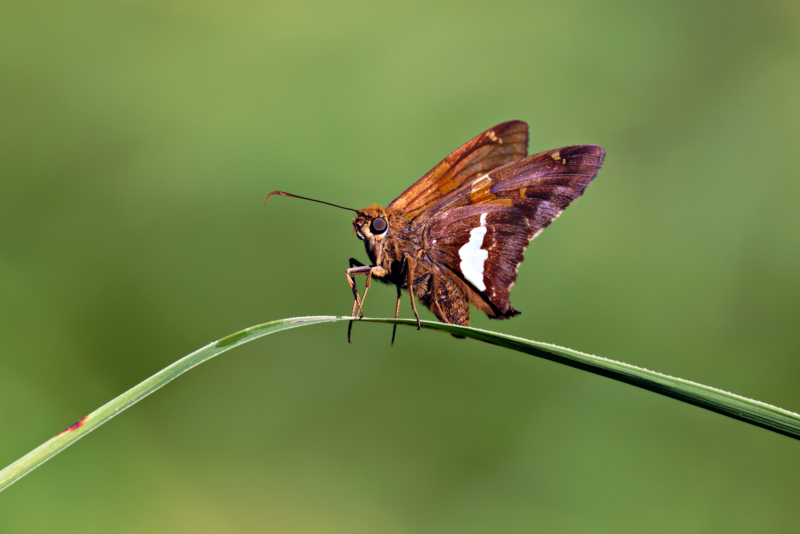
I was walking a quiet utility road at Sequoyah National Wildlife Refuge on August 14, 2024, when a dark butterfly landed close enough to photograph. I didn’t recognize it at first. Back home, I identified it as a Silver-spotted Skipper (Epargyreus clarus), a species I had somehow never noticed before.
Wildlife Notes
Identification and Appearance
The Silver-spotted Skipper is one of the easier skippers to identify once you know what to look for. It has dark brown wings with a bold gold-orange stripe crossing each forewing. The real giveaway is the large silver-white spot on the underside of each hindwing. That spot is unmistakable. Wingspan runs roughly 1¾ to 2¼ inches, which makes it noticeably larger than most skippers you’ll see in Oklahoma.
One behavior worth knowing: Silver-spotted Skippers often rest upside down on the undersides of leaves. This is especially common during hot afternoons and on overcast days. I didn’t catch that in the field this time, but it’s a useful thing to watch for.
Habitat and Range
Sequoyah NWR is good habitat for this species. The refuge has open woods, brushy edges, and riparian corridors, all places where Silver-spotted Skippers feel at home. They’re adaptable insects. You can find them in disturbed areas, forest edges, prairie waterways, and swamps across much of North America, from southern Canada through the continental U.S. and into northern Mexico.
Life Cycle and Behavior
The larvae of this species are leaf-shelter builders. They cut and fold leaves to create a hiding spot and live inside it. When threatened, the caterpillars can release a foul-tasting fluid to deter predators. Females lay single green eggs on host plants, mainly legumes like black locust, false indigo, and American wisteria.
Adults favor nectar from flowers in shades of blue, red, pink, and purple. They tend to skip yellow and white flowers. Multiple broods occur through the season in Oklahoma, so adults are active from spring well into fall.
Photography Notes
Gear and Settings
I used the Canon EOS R5 with the RF 200-800mm F6.3-9 IS USM for this shot. Insects that small require real reach. At 800mm, I filled the frame without crowding the butterfly or putting it on alert.
Settings for this image:
- Focal Length: 800mm
- Aperture: f/9
- Shutter Speed: 1/1000 sec
- ISO: 400
- Exposure Compensation: -2/3 EV
- Support: Handheld
In the Field
The -2/3 exposure compensation was deliberate. Dark brown wings can fool a meter into overexposing. Pulling the exposure back helped retain wing detail and kept the silver spot from blowing out. At 1/1000 sec, I had enough shutter speed to freeze any wing movement. ISO 400 kept things clean in the August light.
I was shooting handheld on the utility road, which put me at a useful low angle for a small subject. Working with skippers and other insects is mostly a patience game. I moved slowly, kept my gestures minimal, and waited for the butterfly to settle before pressing the shutter.
Closing
The Silver-spotted Skipper was a new species for me, and it turned out to be one of the more photogenic insects I’ve come across at Sequoyah. If you’re visiting the refuge in summer, slow down along those utility roads and field edges. Small things are easy to walk past, but they’re worth stopping for.