Whenever I visit Wichita Mountains Wildlife Refuge in Oklahoma, I try to photograph at least one Texas Longhorn. These impressive animals are a big part of the refuge’s history.
On this visit, I wanted to photograph more than just the animal. I also wanted to show the beautiful landscape where these longhorns roam.
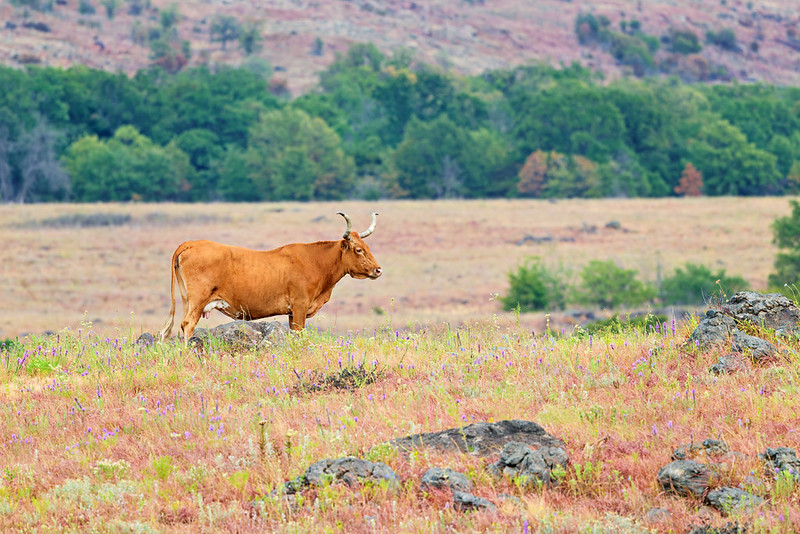
Photographing a Texas Longhorn in Its Habitat
I photographed this Texas Longhorn standing among scattered rocks, grasses, and wildflowers. Behind it stretched an open meadow bordered by trees and distant hills.
Rather than filling the frame with the longhorn, I included much of the surrounding landscape.
The photograph gives viewers a better look at the habitat these animals occupy. It also shows another side of the Wichita Mountains beyond the large granite formations that attract so much attention.
Texas Longhorns have an important place in the refuge’s history. The herd was established in 1927 to help preserve a breed that had once played a major role in the American cattle industry.
I have written about that history in How the Wichitas Saved the Texas Longhorn.
I have also shared another encounter in my post, Wild Texas Longhorn.
Why Visitors Should Keep Their Distance From Texas Longhorns
One thing that concerns me during my visits is how closely some people approach these animals.
On every trip, I see visitors walking toward Texas Longhorns to pose for photographs. Some seem unaware of the danger.
Although Texas Longhorns are domestic cattle, the animals at Wichita Mountains Wildlife Refuge roam freely. They should not be treated like tame cattle accustomed to being handled by people.
The U.S. Fish and Wildlife Service makes its warning clear:
“Bison and longhorn are free roaming. For your safety and theirs, do not approach them.”
The refuge also warns that these large animals can be dangerous.
A longhorn may appear calm while standing or grazing. That does not mean it is safe to walk up to it.
These cattle are powerful animals with long, pointed horns. An animal that becomes startled, threatened, or defensive could seriously injure someone.
Visitors should admire and photograph them from a safe distance. There is no reason to approach a longhorn just to get a better photograph.
You can read the refuge’s official warning on its visitor information page.
Appreciating the Longhorns and Their Surroundings
I have visited Wichita Mountains Wildlife Refuge for years, and I never get tired of seeing these animals.
Their impressive horns make them interesting photography subjects. Watching them move through the landscape is just as enjoyable. Their important role in the refuge’s history adds to my appreciation.
This photograph is a little different from the close-up longhorn portraits I usually try to capture.
By including the rocks, grasses, wildflowers, and distant trees, I wanted to show more of their surroundings.
The Texas Longhorn belongs in this scene, and the landscape helps explain why I enjoy returning to this refuge.
I hope visitors will take the time to appreciate these animals without approaching them. A good photograph is never worth risking an injury or disturbing an animal.
A beautiful animal in beautiful land. I love the photo and appreciate the safety information