I spotted this Prothonotary Warbler near Sally Jones Lake at Sequoyah National Wildlife Refuge in Oklahoma. It was working in a dead tree, moving in and out of a cavity as it built its nest.
I was able to park at the Baker Parking Area turnaround and watch the process from my pickup.
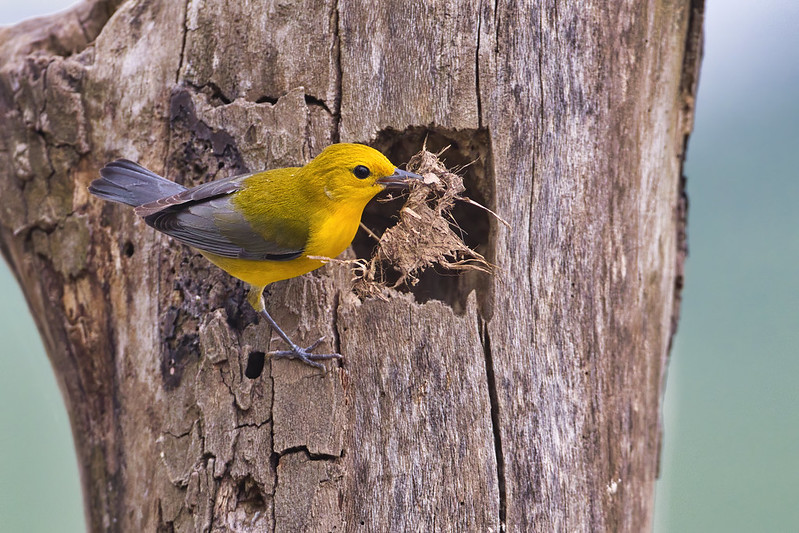
Prothonotary Warbler Nesting in a Dead Tree
The Prothonotary Warbler is one of the few American warblers that often nests in cavities. This bird was using a hole in a standing dead tree.
These warblers may use old woodpecker holes, natural cavities, hollow stumps, or nest boxes. Their nests are often near or over water.
That fit this scene well. The bird was working near Sally Jones Lake, where dead trees and wet habitat give these birds useful nesting sites.
The nesting season begins in early April. Males usually arrive on the nesting grounds before females. They set up territories with song, displays, chases, and fights.
The male may choose several possible nest sites. The female makes the final choice.
Once the nest is active, the female lays at least five eggs. She incubates them for about 12 days. Both parents feed the young after they hatch.
Watching the Warbler Work Near Sally Jones Lake
This tiny bird stayed busy. It made repeated trips to the cavity with nesting material.
Each trip was quick. The warbler would disappear into the hole, then come back out to gather more.
That steady movement made the scene interesting to watch. It also made timing the photo a challenge.
I wanted to show the bird’s behavior, not just a perched portrait. The nesting material and cavity helped tell that story.
The dead tree also gave the photo a clear setting. It showed where the bird was working and why this spot mattered.
Photographing Nest Building From My Pickup
I photographed this Prothonotary Warbler from my pickup. I had my camera and lens resting on a bean bag over the open window.
That setup gave me a steady platform without needing to get out and move around. It also let me stay in one place while the bird kept working.
The photo was taken on April 28, 2020, at 7:38 A.M.
Camera settings:
- Camera: Canon EOS 7D Mark II
- Lens: Canon EF 500 mm f/4L IS USM
- AV Mode
- Aperture: f/5.6
- ISO: 2000
- Shutter speed: 1/640 sec.
- Exposure Compensation: +1/2 EV
- Focal length: 500 mm
This was one of those moments where patience paid off. The bird kept returning to the same cavity, and I had a clear view from the turnaround.
I always enjoy seeing nesting behavior in the field. It gives a glimpse into the work these birds put into raising the next generation.