A black snake can be tough to identify at first glance. I originally asked if the snake in my photo was a North American Racer or a Rat Snake. That question comes up often because both snakes can be dark, long, and non-venomous.
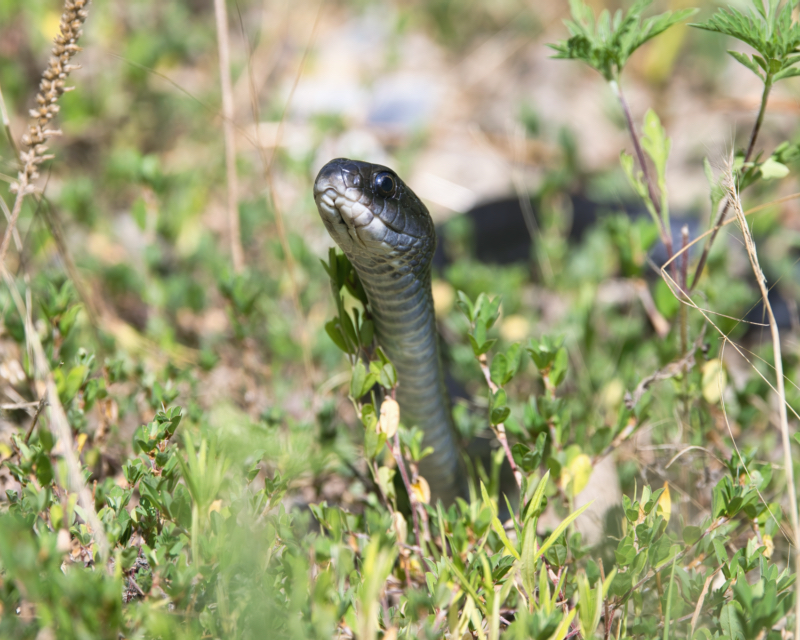
The trick is not to rely on color alone. A quick look at body shape, scales, belly pattern, head shape, and behavior can help separate a racer vs rat snake in the field.
Racer vs Rat Snake: Start With Body Shape
A North American Racer usually looks long, slim, and built for speed. It has a slender body, a head that is only slightly wider than the neck, and large, noticeable eyes. Racers often look smoother and more streamlined than rat snakes.
A Rat Snake usually looks heavier. In Arkansas, the snake most people are comparing with a racer is often the Western Ratsnake. It can be large, dark, and strong-bodied. Rat snakes also tend to have a body shape that looks a little squared off or loaf-shaped instead of perfectly round.
That body shape is one of the first things I look for in a photo. If the snake looks slim and fast, I start thinking racer. If it looks heavier and more muscular, I start looking closer for rat snake clues.
Racer vs Rat Snake: Check The Scales And Belly
The scales are one of the best clues, but they are not always easy to see in a photo.
North American Racers have smooth scales. That gives them a slick, glossy look when the light hits them right. Rat snakes have weakly keeled scales. Keeled scales have a slight ridge down the center, which can make the snake look a little rougher or less polished up close.
The belly can also help. A racer usually has an unmarked belly. A Western Ratsnake often has a black-and-white checkered belly. If a photo shows the underside, that checkered pattern can be a strong clue for rat snake.
Of course, most of my snake photos are taken from a safe distance. I do not handle snakes just to check a belly pattern. If the photo does not show that detail, I use the other clues instead.
Racer vs Rat Snake: Look At The Chin, Lips, And Pattern
Adult racers are often dark gray, black, bluish black, or olive. They usually have a lighter chin, throat, or lip area. Their body pattern is often plain as adults.
Western Ratsnakes can also look dark, but they often show cream-colored lips, chin, and throat. Some also show small pale specks between the dark scales. That can be a useful clue when the photo is sharp enough.
Young snakes make the ID harder. Juvenile racers are blotched, and juvenile rat snakes are also patterned. A young Western Ratsnake is usually gray with dark blotches and may show a dark bar from the eye toward the jaw. That eye stripe can help point toward rat snake.
This is why a young racer or rat snake can fool people. Juveniles do not always look like the adults.
Racer vs Rat Snake: Behavior Helps, But It Is Not Proof
Behavior can support an ID, but I would not use it by itself.
A racer often lives up to its name. If it feels exposed, it may take off quickly. Racers are active hunters and are often seen moving during the day.
Rat snakes are well known for climbing. They may turn up in trees, barns, sheds, birdhouses, and around old buildings while hunting rodents, birds, or eggs. They can also hold still, kink their body, vibrate their tail, or release musk when threatened.
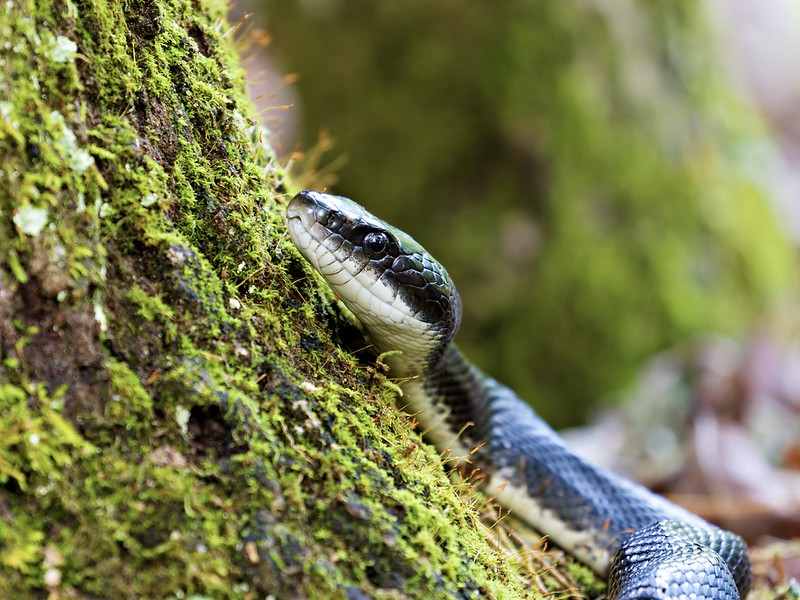
This photo is a good example of why climbing behavior can point toward a ratsnake, especially when the snake also shows a heavier body and pale chin.
A racer can climb some, and a rat snake can move fast when it wants to. So behavior is helpful, but the body and scale clues matter more.
My Racer vs Rat Snake Checklist
Here is the simple checklist I would use when looking at a photo:
More likely a North American Racer if:
- The body looks long, slim, and smooth.
- The eyes look large and alert.
- The scales look glossy and smooth.
- The belly looks plain or unmarked.
- The snake takes off quickly across open ground.
More likely a Rat Snake if:
- The body looks heavier or more muscular.
- The body looks slightly loaf-shaped.
- The scales look weakly keeled or rougher.
- The belly shows a black-and-white checkerboard pattern.
- The snake is climbing a tree, wall, shed, or barn.
- The lips, chin, or throat look cream-colored.
- A young snake has gray blotches and a dark eye-to-jaw stripe.
Why Color Alone Can Mislead You
The biggest mistake is calling every dark snake a racer or every large black snake a rat snake. Color can overlap. Age also changes the pattern.
A young racer may have blotches. A young rat snake may have blotches. An adult rat snake may look mostly black. An adult racer may also look mostly black. That is why I try to use several clues together instead of making the ID from color alone.
The best photos for identification show the whole body, the head, the side of the face, the scales, and the belly if visible. Location also matters because different rat snake species and color forms occur in different parts of the country.
Final Thoughts On Racers And Rat Snakes
Whether this snake turns out to be a North American Racer or a Rat Snake, both are useful, non-venomous snakes. They help control small animals and are part of the natural balance around yards, fields, and woods.
If I am unsure about an ID, I take photos from a safe distance and compare the details later. For Arkansas snake identification, I often use Herps of Arkansas because it gives clear information on snakes found in the state. With racers and rat snakes, the best clues are body shape, smooth or keeled scales, belly pattern, and behavior.
That combination gives me a much better answer than color alone.