A bright splash of blue caught my eye while I was driving through the refuge. It was a male Indigo Bunting working the tall stems of Johnson Grass along the roadside. I pulled over to watch this small songbird use a clever method to reach his morning meal.
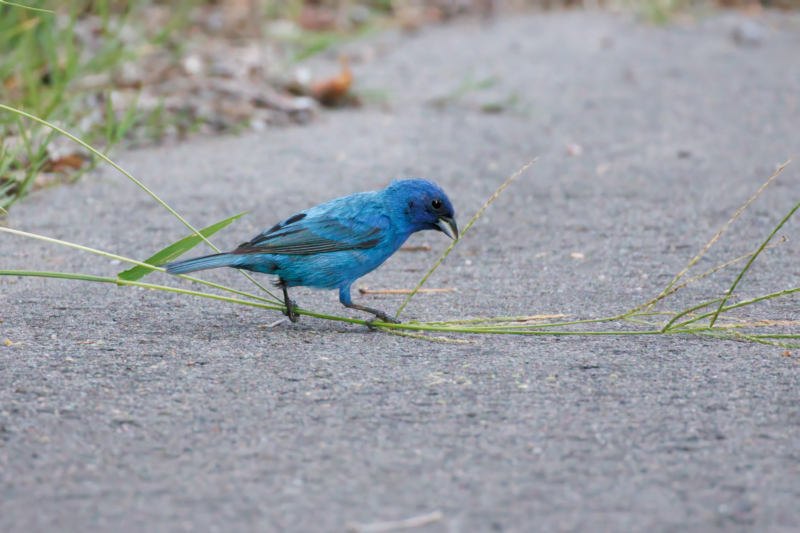
Indigo Bunting Feeding Trick in Summer Grass
The tall, coarse stalks of Johnson Grass present a unique challenge for small birds. The heaviest seed heads sit right at the very top of the plant. These thin stems cannot support the weight of a bird standing upright. To solve this, the bird uses a clever feeding trick. He lands high on a stalk, causing it to bend slowly under his weight. As the stem bows toward the ground, he rides it all the way down. He then pins the seed head to the earth with his feet to feast on the grains.
This behavior is common during late summer at Sequoyah National Wildlife Refuge in Oklahoma. The refuge fields are filled with dense patches of invasive grasses. These plants provide an abundant food source for migrating songbirds. Watching this little bird balance and maneuver showed how adaptable wild creatures can be. For another look at these colorful birds, you can read about a magical encounter with a male Indigo Bunting.
Photographing a Songbird from the Truck Window
I picked a steady vantage point by using my pickup truck as a mobile blind. The bird was foraging close to the road edge. This allowed me to look directly out of the open window. Remaining inside the cab kept the bird comfortable and undisturbed. It also provided a solid resting spot to brace my camera equipment.
The bright summer sun was climbing, which brought out the rich blue in his feathers. Indigo Buntings do not actually have blue pigment. Instead, their microscopic feather structure refracts the light, making them look almost electric. I moved my lens slowly to avoid sudden movements that might scare him away.
Camera details:
- Camera: Canon EOS R7
- Lens: Canon RF 800
- Location: Sequoyah National Wildlife Refuge, Oklahoma
- Date and time: July 22, 2023, 09:08 A.M.
- Aperture: f/11
- Shutter speed: 1/800
- ISO: 10000
- Exposure compensation: +0.7
- Focal length: 800 mm
Why This Seed Feeding Behavior Caught My Eye
Moments like this make roadside wildlife photography incredibly rewarding. It is one thing to see a bird perching, but watching a specific survival behavior adds depth to the experience. The bunting stayed in the grass for several minutes, repeating his clever routine on different stalks.
This simple encounter reminded me to look closely at common roadside species. The interaction between the songbird and the heavy grass made for a clean, compelling scene. I watched him finish his meal before he finally flew back into the thicker brush.
I enjoy your enjoyment as much as the photos! Thanks for letting us see behind the scenes!
I’m so glad you were there to catch such an interesting as well as beautiful moment. Thanks, Steve!
Birds are brilliant. Thanks for sharing the story behind this image.