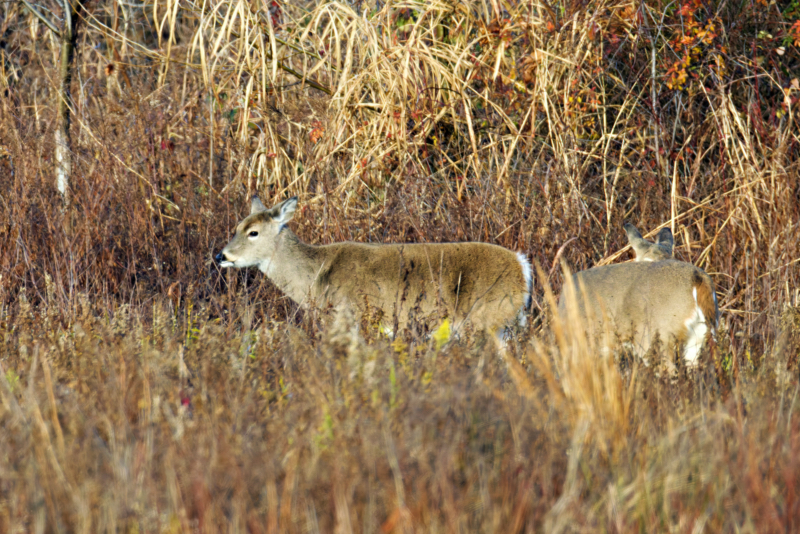
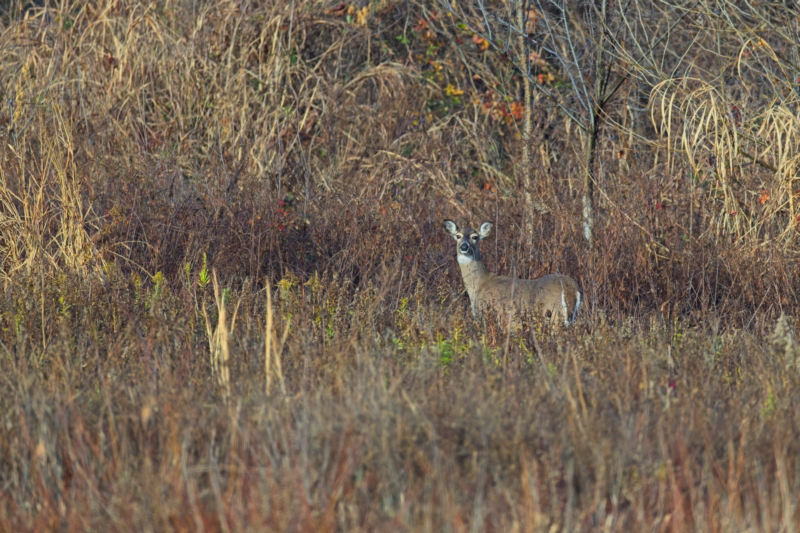
I photographed this white-tailed doe at Sequoyah National Wildlife Refuge in Oklahoma in mid-December. She looked to be in fine shape. A full coat, a rounded body, and her head up and ears on the whole time I watched her.
Signs Of A Healthy White-tailed Doe At Sequoyah
Start with the coat. It was thick and full, smooth from her neck to her flanks, with no rough patches. I’d say a coat like that comes from good food and a body that is not carrying parasites.
Her body told the same story. She was rounded through the middle and along her flanks, not ribby at all. A deer going into winter in that shape has been eating well.
Then there was the way she carried herself. Head up, ears up, watching everything around her. She did not move like a deer bothered by injury or illness, and her tail was clean and fluffy. Put it together and she read as a healthy deer in a good place.
Two Frames At 800 mm
The first frame is the profile. She stood in tall dry grass with the sun on her coat, and a second deer stood half hidden at the right edge of the frame, showing mostly rump and ears. The second frame is wider. She faced me head-on in the grass and brush, ears up, and that one shows how well she blends into a December field.
I shot both frames with my Canon EOS R5 Mark II at 800 mm, at f/9 and 1/2000 of a second, with the ISO at 3200. At 800 mm the tall grass around her goes soft, and she stays the sharp part of the frame.
- Camera: Canon EOS R5 Mark II
- Focal length: 800 mm
- Aperture: f/9
- Shutter speed: 1/2000 sec
- ISO: 3200
Good Habitat Shows On The Deer
Sequoyah gives White-tailed Deer a mix of woodland, grassland, and open water. The menu is a long one: grasses, shrubs, acorns, and persimmons. In fall and early winter the acorns matter most, because that high-energy food helps deer hold their condition as the cold sets in.
A photo cannot run a health check on a deer. What it can do is show the coat, the body, and the behavior on one December morning, and in these two frames all three pointed the same way. Ground like Sequoyah is why a doe can look this good going into winter. Tell me about the deer you have been seeing this season in the comments.
Fawns are the other half of this story. I once photographed a bedded whitetail fawn tucked down in the grass, staying hidden the way fawns do.