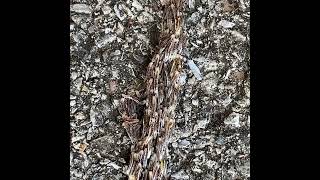
I came across this group of fungus gnat larvae while walking near the Ouachita National Forest in Arkansas. At first glance, it looked like a dark line stretched across the gravel road. Once I stopped and watched for a moment, the movement became obvious.
This video shows dozens of fungus gnat larvae moving together as a single, wriggling mass. Instead of spreading out, they stayed tightly packed and continued forward as one unit. The motion was slow but steady, and the group held its shape the entire time I watched.
Seeing this behavior in motion tells a very different story than a still image. In a photo, it can look like debris, a crack in the road, or even a small snake at a distance. The video makes it clear that this is a coordinated movement, not random wandering. Each larva contributes to the overall motion, creating that rippling effect as the group advances.
I filmed this from a close distance without interfering. The larvae continued moving uninterrupted, which suggests this is normal behavior rather than a response to disturbance. They crossed exposed ground in full daylight, which stood out to me since individual larvae are usually hidden in soil or decaying organic matter.
This kind of mass movement is not something most people ever notice, even though fungus gnats are common. You usually see the adults around plants or lights, not the larvae traveling together across open ground. That is what made this moment worth recording.
If you want to dive deeper into why fungus gnat larvae move this way and what scientists think is happening inside these wriggling groups, I break that down in a separate post here: Fungus Gnat Parade! The Science Behind the Wriggling Mass
This video stands on its own as a field observation. It shows behavior most people never get to see, happening out in the open, in real time. That is often where the most interesting wildlife moments show up, right under your feet when you are paying attention.