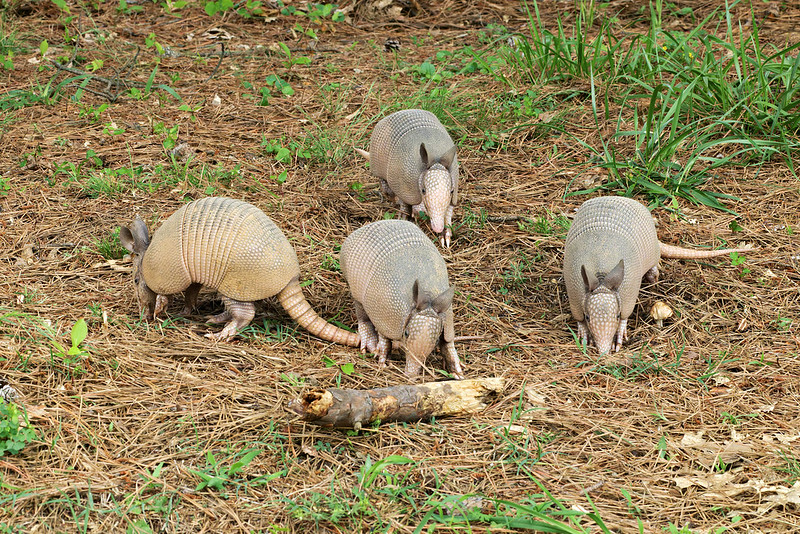
These four young armadillos gave me a wildlife moment I won’t forget. I photographed them in my yard here in Arkansas. They showed up together and started foraging through the pine needles. Each pup had its nose to the ground, focused on sniffing out insects or worms.
All Eyes on the Ground
What makes this moment special is that all four siblings are in the same frame. You can clearly see each of their eyes. That’s a first for me. I often photograph single armadillos, but this was the first time I caught four together like this.
Juvenile Nine-Banded Armadillos sometimes stay close to their littermates after birth. It was interesting to see them move as a group. They didn’t scatter or wander off. Instead, they stayed side by side while foraging.
Why I’m Sharing One More Post
I’ve already shared other posts from this rare encounter. But I wanted to write one more. I may never see something like this again, especially in my own yard.
You can check out the other posts here:
- Baby Nine-Banded Armadillos in My Yard
- Young Nine-Banded Armadillo Eating Earthworms in My Yard
- Armadillo Pup Sniffs My Boot in a Curious Encounter
Camera Settings
- Camera: Canon EOS R5 Mark 2
- Lens: RF 100-500mm F4.5-7.1 L IS USM
- Aperture: ƒ/16
- Focal Length: 100 mm
- Shutter Speed: 1/1250
- ISO: 6400
- Exposure Compensation: 0
Photo Tip:
I don’t often shoot at ƒ/16, but in this case, I wanted to make sure all four armadillos were in sharp focus. I was close to them, so using a smaller aperture helped increase the depth of field. To maintain a fast enough shutter speed, I raised the ISO to 6400. The Canon EOS R5 Mark II handles high ISO very well, making this kind of shot possible without excessive noise.
Update on Armadillo Species Name
Since this post was originally published, scientists have reclassified the armadillos found in Arkansas and Oklahoma. What was once identified as the Nine-banded Armadillo (Dasypus novemcinctus) in this article is now recognized as a separate species called the Mexican Long-Nosed Armadillo (Dasypus mexicanus).
The animal in these photos has not changed. Our understanding of its genetics has.
You can read the full explanation of this name change here: Mexican Long-Nosed Armadillo: The Nine-Banded Name Change
Very good photography, Steve !