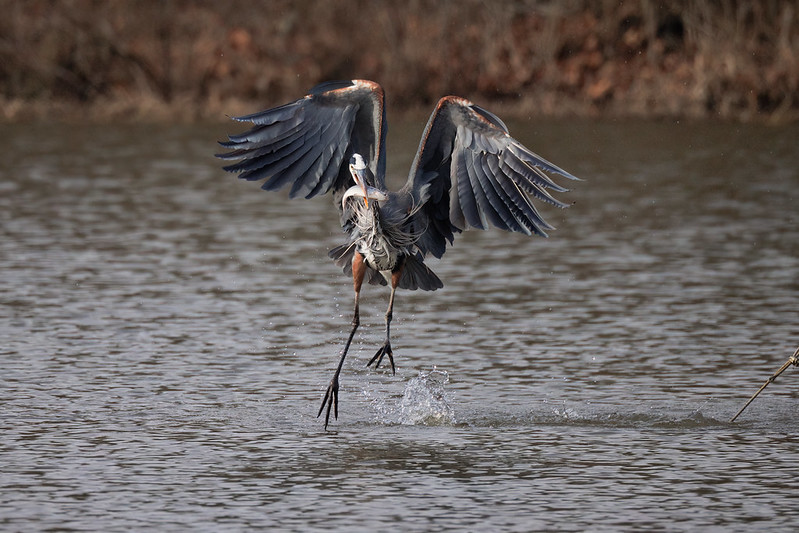
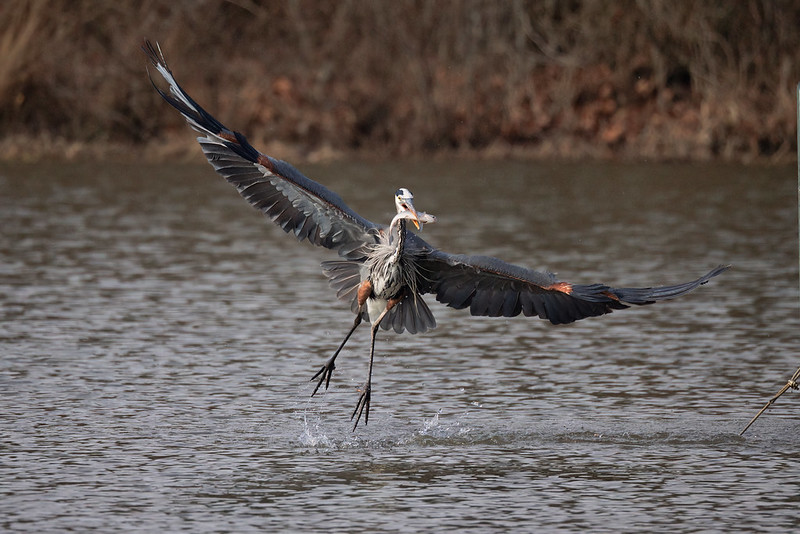
Some wildlife moments last about two seconds. This was one of them. A Great Blue Heron grabbed a shad near the dam, then lifted off and headed for shore to eat it.
Wildlife Notes
I photographed this heron at Charleston City Lake in Charleston, Arkansas. It was hunting near the dam, using a floating platform as part of its routine. I watched it jump off that platform to catch shad, then fly to land to handle the fish.
A Great Blue Heron looks calm, right up until it is not. When it commits to a strike, everything happens fast. After the catch, the job is not done. A shad is slick and awkward. The heron has to keep a tight grip, fly without losing it, then reposition the fish before swallowing.
That “move it around in the bill” step is where I see a lot of misses. The heron has to get the fish lined up headfirst. If it does not, the fish can slip free.
Photography Notes
This was a quick action sequence, so shutter speed mattered more than anything. I shot at 1/3200 to freeze the wing motion and keep the shad sharp. The light was bright enough that I could stay fast without pushing ISO into ugly territory.
Gear Used:
- Camera: Canon EOS R5
- Lens: Canon RF 800mm F11 IS STM
Technical:
- Location: Charleston City Lake (Arkansas
- Date and Time Taken: January 9, 2023 (11:16 A. M.)
- Aperture: f11 (Fixed)
- Shutter speed: 1/3200
- ISO: 2000
- Exposure Compensation: -4/3
- Focal Length: 800 mm (Fixed)
If you want more keepers on birds flying toward shore, here’s what helps me most:
- Track early. I get on the bird as it prepares to launch, not after.
- Stay steady. From a vehicle, a bean bag on the window frame is hard to beat.
- Leave room in the frame. A little extra space helps when the wings flare.
Closing
Charleston City Lake keeps paying off because the birds there act natural. They do not seem bothered by a parked truck. That gives me a front-row seat when something like this happens.