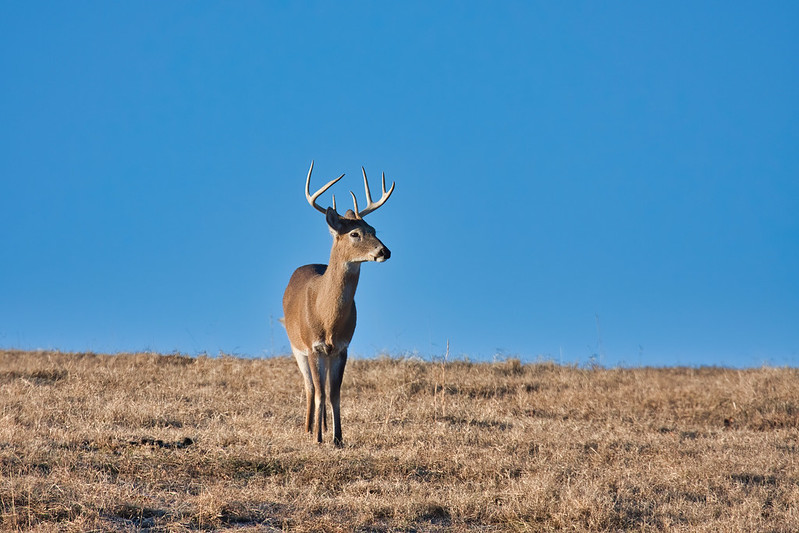
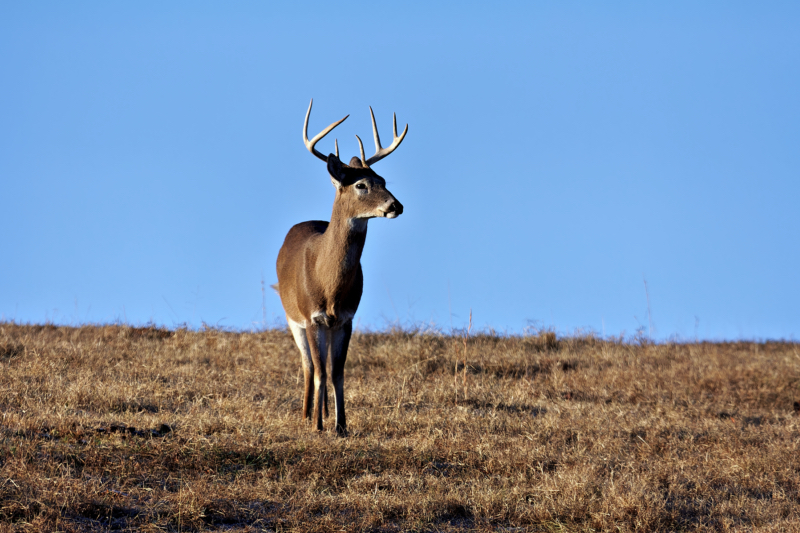
I was driving the back roads near Alma, Arkansas on Christmas Day back in 2007 when I saw this Whitetail Buck in a field. I took several photos before it left the field and went into the woods.
If I remember correctly, I got out of my pickup while hand-holding my camera and lens to get these photos.
Wildlife Notes: Arkansas Whitetail Buck
This buck looks like a seven point whitetail deer, a common species across Arkansas. Bucks grow and shed their antlers each year. By late December most breeding is over, but they still move through open fields to feed and recover from the rut.
The dry grass and open hillside in this field made the deer easy to see from the road. Habitat like this, near woods, gives deer quick access to both food and cover.
His posture tells a lot. The head is high, ears turned, and the body is angled slightly as if he is ready to step off. He was alert but not panicked, watching and listening while he decided whether to stay or melt back into the woods.
Winter coats on whitetail deer are dense and gray brown. They blend well with dormant grass and bare ground. The white throat patch and the underside of the tail still stand out and help with identification, even at a distance.
On that cold Christmas morning he gave me a short window. After a few moments of standing broadside, he turned and walked toward the woods and disappeared. Encounters with mature bucks in the open rarely last long, especially in late season.
Photography Notes: Photographing an Arkansas Whitetail Buck
This was an older setup for me:
- Camera: Canon EOS 40D
- Lens: Canon EF 100–400 mm f/4.5–5.6L IS USM
- Mode: Aperture Priority
- Aperture: f/7.1
- Shutter Speed: 1/1250 sec
- ISO: 400
- Exposure Compensation: 0 EV
- Focal Length: 400 mm
I first spotted the buck from my pickup. I stopped on the shoulder and used the truck as a blind so I did not rush him. Once I saw that he was still calm, I slipped out of the cab with the camera in hand.
I chose aperture priority at f/7.1 to keep the whole deer sharp while still giving me some background blur. The camera selected 1/1250 second at ISO 400, which was fast enough to freeze any small movement in his head or legs. With wildlife, I prefer to keep shutter speed high when I can.
Shooting at 400 mm let me frame the buck tight enough for detail but still keep a wide sweep of sky and field. The slight rise of the hill helped hide clutter in the foreground and gave me a clean horizon line. That simple curve is a big part of why the image feels minimalist.
The light was soft and cool, coming from my left. I made sure my shadow stayed behind me so I did not throw any dark shape across the field. The side light carved out the shape of his neck and antlers without harsh contrast.
I hand held the lens for this series. Image stabilization on the 100–400 helped, but at 1/1250 second I was more concerned with quick framing than camera shake. I fired several frames as he shifted his head and ears, then stopped when he turned toward the woods so I did not push him.
Closing Thoughts
Christmas morning can look different for everyone. For me, that quiet drive near Alma turned into a brief meeting with a wild Arkansas whitetail buck under a blue sky.
Moments like this are the reason I keep driving those back roads. You never know when a simple field and a strip of winter grass will hold something worth remembering.