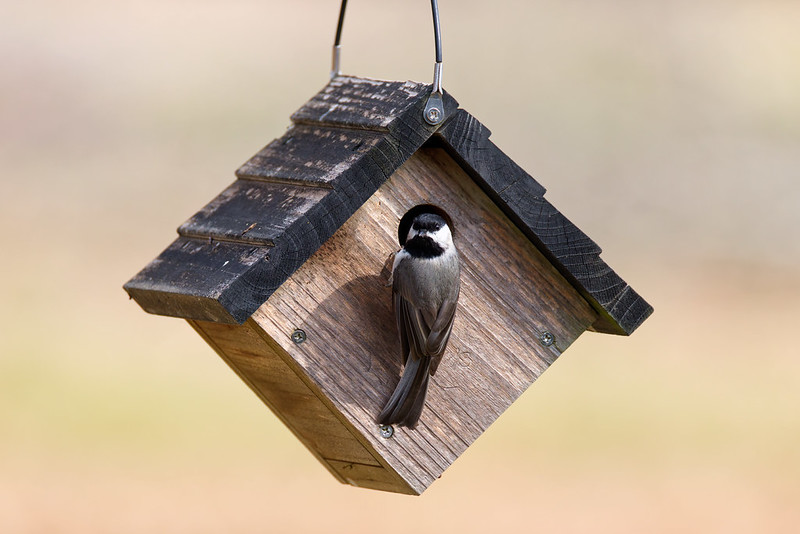
It looks like I have a returning tenant. A Carolina Chickadee is checking out the same birdhouse this March that was featured in my post from last year, Chickadees Join Bluebirds in Spring Nesting Season. I watched it going in and out on two separate days, a few days apart, and managed to photograph it each time.
Wildlife Notes: Carolina Chickadee Birdhouse Nesting Behavior
Carolina Chickadees are tiny birds, roughly 4.5 inches long, but they carry a lot of personality. Birders across the Southeast know them well for their black cap, black bib, white cheeks, and soft gray wings. They are year-round residents in Arkansas, so they do not migrate. When March arrives, though, their behavior shifts noticeably toward nesting.
What I was watching is called nest-site prospecting. A chickadee will visit a potential cavity repeatedly before committing to it. The fact that this bird came back a few days later and kept going in and out is a stronger sign than a single visit. Repeated returns suggest the bird has not found anything better nearby and is still seriously evaluating this spot.

That shot above captures exactly what prospecting looks like. The bird is peering out from inside, sizing things up. It stayed there for a few seconds before making its decision.
Carolina Chickadees generally prefer cavities with entrance holes between one and 1.25 inches in diameter. That smaller opening helps keep larger, more aggressive birds out. This birdhouse seems to fit the bill, because a chickadee used it last spring too.
Whether this is the exact same individual from last year, I honestly cannot say with certainty. Chickadees do show site fidelity, meaning they tend to return to areas where they nested successfully before. That said, it could also be a different bird that found an already-suitable location. Either way, the behavior is the same.
For more on how chickadees and bluebirds share the yard during nesting season, see Carolina Chickadees Compete for Nesting Spot.
Photography Notes: Catching the Full Sequence from the Deck
I photographed this sequence across two separate sessions from my deck, a few days apart. The chickadee was calm both times, which tells me it was comfortable with my presence at that distance. That kind of tolerance is exactly what you want when working near a potential nest site. Any pressure at this stage could cause the bird to abandon the location.
Photo 1 was from the first session:
Camera: Canon EOS R5 Mark II Lens: RF 200-800mm F6.3-9 IS USM Focal Length: 800mm Aperture: f/10 Shutter Speed: 1/1000 sec ISO: 1000 Exposure Compensation: 0 Support: Bean bag on deck rail
Photos 2 and 3 came a few days later, same deck position:
Camera: Canon EOS R5 Mark II Lens: RF 200-800mm F6.3-9 IS USM Focal Length: 800mm Aperture: f/10 Shutter Speed: 1/2000 sec ISO: 1600 Exposure Compensation: 0 Support: Bean bag on deck rail
The light was a little different on the second day, which is why I bumped the ISO to 1600 and pushed the shutter to 1/2000 sec. I also wanted the extra speed in case the bird made a move, which it did.

That departure shot was not planned. The bird popped out and launched before I could react. I just kept the shutter going. Even at 1/2000 sec, the wings still show a hint of blur. Chickadees have a very fast wingbeat, so truly frozen wings often need 1/3200 sec or faster. That said, the spread is clear enough to read the full shape of the wing, and the motion in the tips sells the energy of the moment better than a perfectly frozen frame might.
One thing I have found with chickadees at birdhouses: patience pays off more than repositioning. They cycle in and out quickly. If you stay still and wait, they settle back down fast. Move around too much, and you lose the shot and possibly the bird.
For more on backyard bird photography from the deck, check out Feeder Favorites: The Tufted Titmouse and Carolina Chickadee.
Watching What Comes Next
Nest-site prospecting is just the first step. If this chickadee decides the birdhouse works, the female will start bringing in nesting materials, usually moss first, then softer fibers. I will be watching closely over the next few weeks to see if things progress.
Have you had Carolina Chickadees nesting in your yard this spring? I would love to hear what you are seeing out there.
Steve,
I have both Chickadees and Bluebirds prospecting my houses so far. A bit later, I hope to attract some Prothonotary Warblers, as I did last year.
Lucky you, to have Prothonotary Warblers.