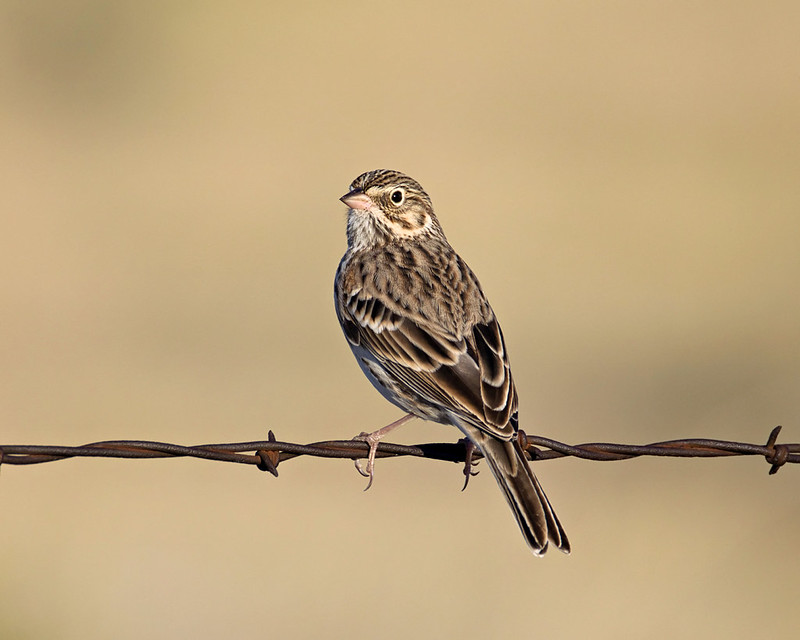
I photographed this Vesper Sparrow beside a gravel road near Black Mesa State Park in Oklahoma. This was the same location where I photographed the Sage Thrashers I shared in my previous post. These two photographs show the sparrow on barbed wire and a dried seed stalk.
Vesper Sparrow Habitat and Identification
TravelOK’s Black Mesa birding guide includes the Vesper Sparrow among the area’s birds. Its preference for open country helps explain why this roadside location suited it.
Vesper Sparrows use grasslands, pastures, weedy fields, and roadsides with short, sparse grass and scattered shrubs. They occupy these kinds of habitats during breeding, migration, and winter. Their range extends across much of North America, so they aren’t limited to western landscapes.
These sparrows spend much of their time on the ground. They scratch for seeds and also eat insects and spiders, especially during the breeding season.
The pale eye-ring stands out in both of my photographs. Other useful features include a streaked breast, a small bill, and white outer tail feathers that show in flight. A chestnut shoulder patch can also help with identification, though it can be hard to see.
Two Perches Beside the Gravel Road
In the first photograph, the sparrow grips a strand of barbed wire with its back toward me. Its turned head gives me a view of the eye-ring and face. I also like how this angle shows the layered wing feathers and dark markings along its back.
The second photograph shows the bird on top of a dried seed stalk. From this angle, more of its pale belly and streaked breast are visible.
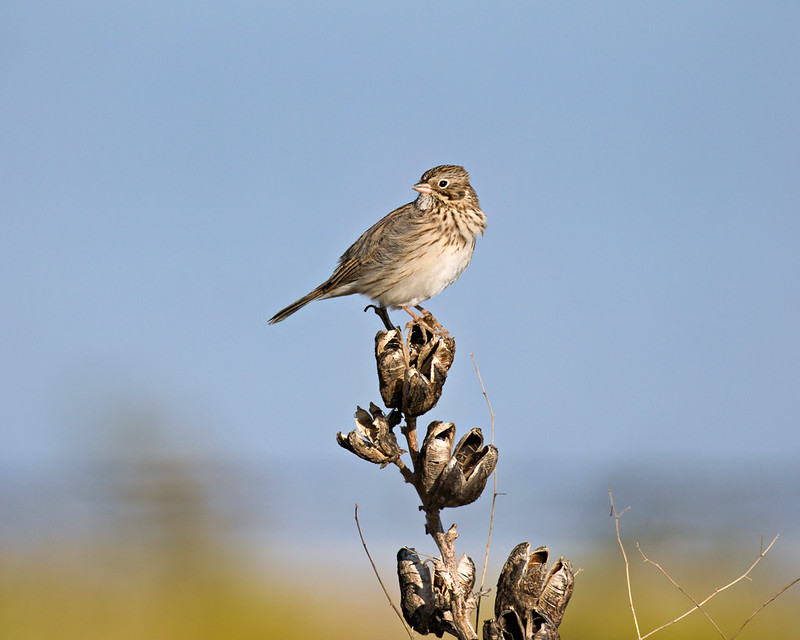
I like having both views. The close fence portrait shows the feather detail, while the wider photograph includes more of the natural perch.
Another Bird From the Same Black Mesa Location
I wrote about my Sage Thrasher Near Black Mesa State Park encounter at this same location. Adding the Vesper Sparrow gives me another species to share from that stretch of gravel road.
Black Mesa draws my attention for its mix of birds, but I enjoy the smaller roadside encounters too. These photographs give me a chance to study markings that can be easy to miss in the field.
Beautiful photos,thank you for them!