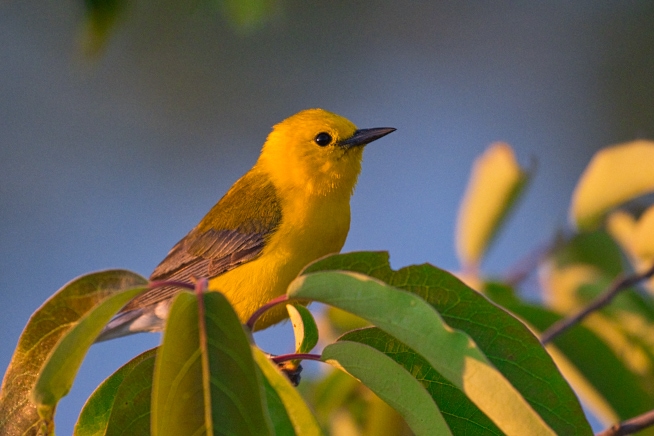
I was set up photographing a Great Blue Heron when this bright yellow Prothonotary Warbler landed right in front of me. Sometimes the best shots happen when you’re already in position and ready. This was at the Sally Jones West Causeway at Sequoyah National Wildlife Refuge in Oklahoma.
Finding Prothonotary Warblers at Sequoyah
Prothonotary Warblers are common at Sequoyah Refuge during spring and summer. They’re one of the few warblers that nest in tree cavities near water. I’ve seen them along the causeway multiple times, usually moving through thick vegetation near the flooded timber.
Wildlife Notes
These birds are sometimes called swamp warblers because they prefer flooded forests and swampy areas. They like habitats with standing water and dense cover. At Sequoyah, the best spots are along the causeway where water meets the tree line.
The males are bright golden yellow with blue-gray wings. Females are slightly duller but still distinctly yellow. They move quickly through branches looking for insects and spiders. They don’t stay still long, which makes clean photos challenging.
Prothonotary Warblers arrive in Oklahoma around mid-April and leave by September. July is peak nesting season, so this bird was likely feeding young nearby. They’re vocal during breeding season with a loud, ringing song that carries across the water.
Why This Shot Worked
I got lucky with this one. The bird landed on an open branch with good separation from the background. Most of the time these warblers stay deep in thick cover where branches and leaves block the view. This one popped out into clear sight for just a few seconds.
Photography Notes
I had my camera on a bean bag draped over my truck’s open window. I was shooting a Great Blue Heron when the warbler appeared. All I had to do was shift the camera slightly to the right.
The bean bag setup kept everything stable at 400mm. Shooting from the truck works well at Sequoyah because birds treat vehicles as part of the landscape. They’ll come much closer than if you’re standing outside.
Camera Settings
I was shooting in aperture priority mode at f5.6. The ISO jumped to 2500 because I was in shade under the tree canopy. Shutter speed was 1/1600 second, fast enough to freeze the bird’s movements. I used a slight negative exposure compensation of -0.03 to protect the bright yellow highlights.
Quick Opportunities in the Field
This encounter lasted maybe ten seconds. The warbler hopped along the branch, tilted its head a couple times, then flew back into the thick vegetation. If I’d been standing outside fumbling with my gear, I would have missed it completely.
That’s why I keep my camera ready on the bean bag when I’m parked along wildlife corridors. You never know what’s going to show up next.