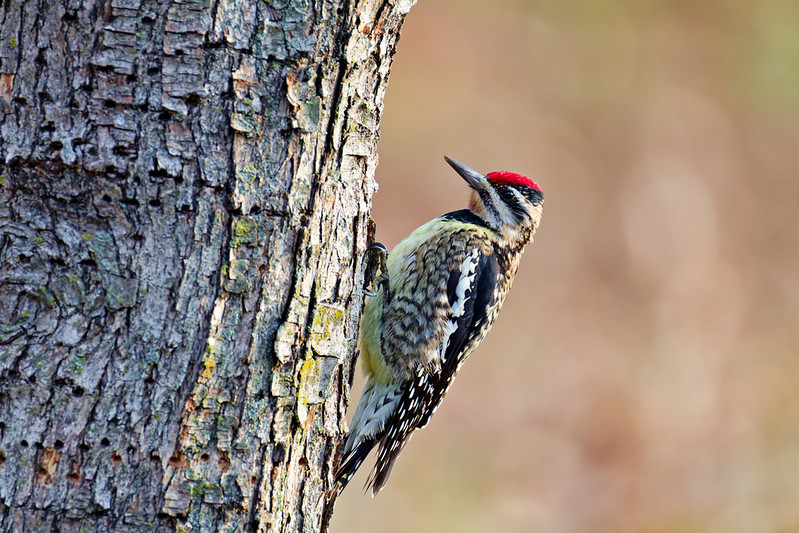
I photographed this Yellow-bellied Sapsucker climbing one of my dwarf pear trees here in Arkansas. What caught my eye right away was not just the bird, but the rows of holes circling the trunk.
That detail tells a big part of the story. This woodpecker was on a tree that already showed the feeding sign Yellow-bellied Sapsuckers are known for.
Wildlife Notes
Yellow-bellied Sapsuckers are a type of woodpecker, but they do not feed quite like the others I usually watch. Instead of only chiseling deep into wood for insects, they drill small, neat holes called sap wells. These holes are often arranged in rows or bands that wrap around the trunk.
That is exactly what stood out on this dwarf pear tree. If you look closely at the bark, you can see those holes circling the trunk. A bird like this returns to those openings to feed on sap and sometimes the insects drawn to it.
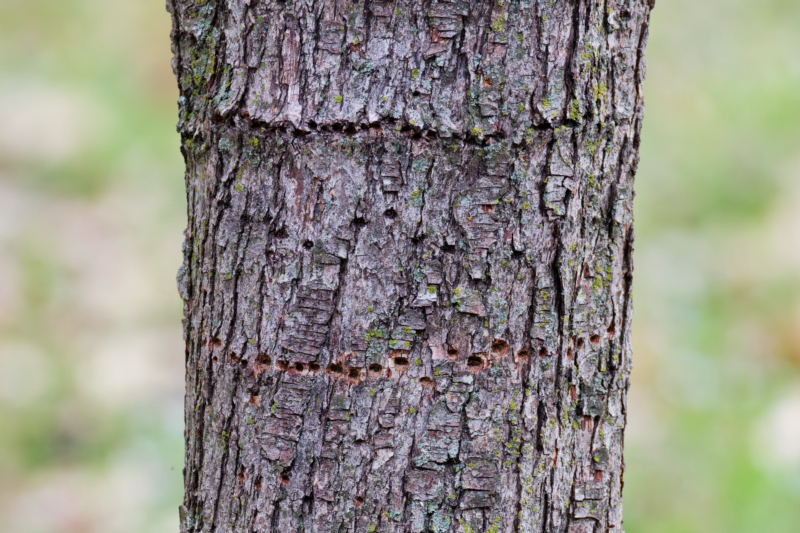
This second photo gives a much better look at the pattern. You can clearly see how the holes form bands around the trunk instead of appearing as random damage. That is one of the easiest clues that a sapsucker has been working a tree.
This bird gave me a good look as it climbed the tree in the typical woodpecker style, using its stiff tail for support and moving upward in short bursts. I always enjoy seeing a bird that leaves such clear evidence behind. In this case, the tree trunk helps explain the behavior as much as the bird does.
Photography Notes
I made this photo from my deck using a beanbag on the rail for support. That setup works well for yard photography, especially when I need to hold a long lens steady and wait for a bird to move into a clean position on the trunk.
For this image, I used my Canon EOS R5 Mark II with the Canon RF 200-800mm lens at 800mm. My exposure was 1/400 second at f/9, ISO 3200. The slower shutter speed worked because the bird paused long enough for me to get a sharp frame.
I like this composition because it shows more than just a portrait. The bird is strong in the frame, but the trunk also shows the bands of holes that explain why the sapsucker was there in the first place. To me, that makes the photo more interesting than a tight crop of the bird alone.
Why This Yellow-bellied Sapsucker Photo Matters
I always like it when a wildlife photo shows behavior, habitat, and field marks in one frame. This one does that. The red crown, the posture on the bark, and the drilled holes in the tree all work together to tell the story.
Backyard wildlife can be easy to overlook, but moments like this remind me that even a dwarf pear tree can turn into a feeding station for a specialized bird.
It was a treat to photograph this Yellow-bellied Sapsucker in my yard here in Arkansas. Seeing the bird on the trunk was nice, but seeing the rings of holes it had made gave the photo even more meaning.
Such a beautiful bird!