I spotted this watersnake while driving through Sequoyah National Wildlife Refuge in eastern Oklahoma. At first I thought I was looking at a stick in the reeds, but a second look told a very different story.
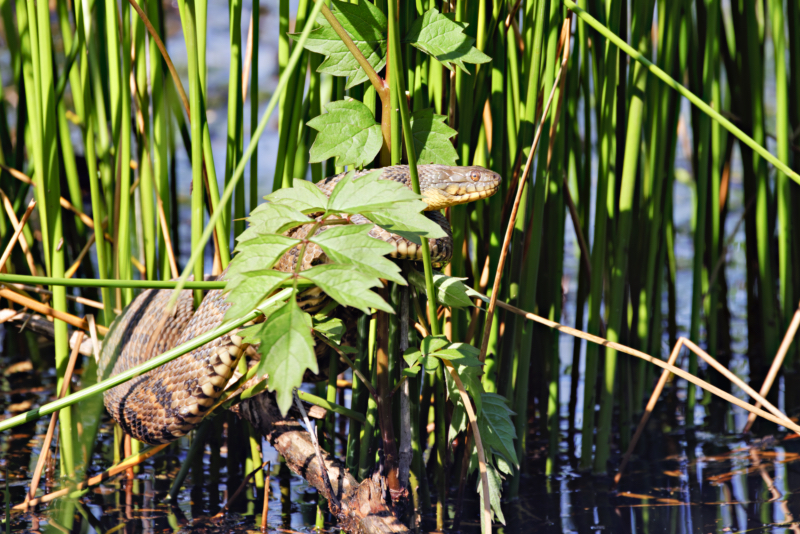
Watersnake in the Reeds
This watersnake was hanging quietly in the reeds and blending in so well that it almost disappeared into the background.
The camouflage is what caught my attention most. The snake’s shape, color, and position made it easy to miss. That kind of still posture can make a watersnake look more like part of the marsh than a reptile.
Based on the pattern and setting, this appears to be a Northern Diamondback Watersnake resting in the reeds at Sequoyah National Wildlife Refuge. These wetlands are a good place to watch for wildlife that uses shoreline cover and shallow water. For another look at snake activity in this area, see Sunbathing Snakes at Sequoyah National Wildlife Refuge
Watersnake Habitat at Sequoyah
Watersnakes are often seen around marshes, sloughs, ponds, and backwaters where cover is close to the water. Reeds, brush, and low branches give them places to rest, hunt, and stay hidden.
That makes Sequoyah National Wildlife Refuge a good place to watch for them. Healthy wet habitat supports a lot of life, and snakes are part of that system. Seeing one tucked into the reeds is a small sign that the marsh is doing its job.
If you visit the refuge, it pays to look twice at anything that seems out of place. A reed bed can hide a lot more wildlife than you expect.
Photography Notes for a Watersnake at Sequoyah
I photographed this snake from the truck, which let me stay steady and avoid pushing too close. The beanbag support on the window helped a lot at 800mm, especially for a subject that could vanish with one quick movement.
The soft cover of the reeds also shaped the image. I wanted to show the snake as part of its habitat, not just isolate it. That setting tells the story better because the camouflage is the whole point of the encounter.
Camera settings:
- Camera: Canon EOS R5
- Lens: Canon RF 800mm F11 IS STM
- Focal length: 800mm
- Aperture: f/11
- Shutter speed: 1/1000
- ISO: 2000
- Exposure compensation: -1/3
- Support: Beanbag on truck window
At that focal length, the beanbag gave me enough stability to hold detail while keeping the framing tight. The shutter speed was fast enough for a sharp wildlife portrait, and the slight negative exposure compensation helped protect bright highlights in the scene.
Closing
Moments like this are why I keep scanning the edges of the road at Sequoyah National Wildlife Refuge. What looks ordinary at first can turn into a good wildlife find with one careful second look.
This sighting also tied nicely to my earlier post about sunbathing snakes in the same area. The refuge keeps proving that if I pay attention, there is always something new waiting in the marsh.