I recently had the chance to photograph two Whitetail Bucks right on my property near the Ouachita National Forest. One was a young three point buck, and the other was a spike. Both animals moved calmly through the woods, giving me a rare and rewarding opportunity to observe and photograph them at close range.

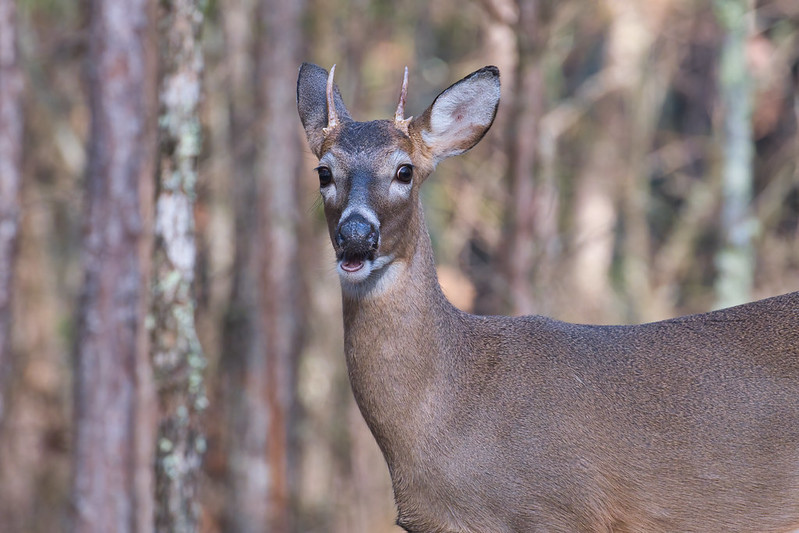
Seeing bucks like this outside of the rut often means they feel safe in their surroundings. Because of that, I focused on staying hidden and letting their natural behavior unfold instead of forcing the shot.
Photographing a Three Point Buck and Spike Without Disturbance
To avoid disturbing these Whitetail Bucks, I set up a ground blind in a strategic location ahead of time. This allowed me to blend into the surroundings and stay still while the deer moved naturally through the area.
From inside the blind, I could watch their behavior without drawing attention to myself. As a result, both bucks remained relaxed, which helped me capture more natural poses and expressions. This approach matters because stressed animals rarely produce good photographs.
Camera Gear Used to Photograph a Three Point Buck and Spike
For this shoot, I used my Fujifilm X-T3 paired with a Canon EF 100–400mm f/4.5–5.6 L IS II USM lens. I mounted the lens using a Fringer EF-FX Pro adapter and kept everything steady on a sturdy tripod.
A longer focal length allowed me to keep my distance while still filling the frame. This helped preserve the deer’s natural behavior and reduced the chance of spooking them.
Location and Timing in Arkansas
I photographed these bucks in Oden, Arkansas, an area known for healthy wildlife populations and quiet forested habitat. The surrounding Ouachita Mountains provide excellent cover and food sources for Whitetail Deer.
I took these photos on November 24 and November 26, 2020, at approximately 9:07 and 9:41 A.M. Morning light worked in my favor by providing soft illumination without harsh shadows.
Exposure Settings for Photographing Whitetail Bucks
I shot in aperture priority mode to control depth of field while allowing the camera to adjust shutter speed. I selected apertures of f/5.6 and f/7.1 to isolate the bucks from the background while keeping enough detail in their faces and antlers.
Shutter speeds settled at 1/150 and 1/420 of a second, which was fast enough to freeze movement. I set ISO to 2500 to balance exposure and noise in the low morning light.
Using a 400mm focal length helped emphasize details like fur texture, ear position, and facial expression. At the same time, it allowed me to maintain a respectful distance.
Observing Natural Behavior of a Three Point Buck and Spike
Beyond the photography, watching these two bucks interact with their environment was just as rewarding. They moved slowly, paused to scan the woods, and fed without showing signs of alarm.
Moments like this are a reminder that patience often matters more than speed in wildlife photography. When animals feel safe, the images usually reflect that calm.
Other Wildlife Encounters Nearby
While focusing on these Whitetail Bucks, I also photographed a Tom Turkey on Thanksgiving Day and a young deer watching birds nearby. These encounters highlight the diversity of wildlife that lives in this part of Arkansas.
Each outing brings something different, even when I stay close to home.
Final Thoughts on Photographing a Three Point Buck and Spike in Arkansas
Photographing a three point buck and a spike in Arkansas was a rewarding experience that reinforced the importance of patience, preparation, and respect for wildlife. By staying hidden and allowing the scene to unfold naturally, I was able to capture images that reflect how these animals truly live.
Protecting habitat and minimizing disturbance ensures moments like this remain possible for future generations. Through photography, I hope to encourage appreciation and conservation of Arkansas wildlife.