Most people think of Mourning Doves as soft brown birds with a simple look. That is true at a glance, but good light can show a lot more color than most people expect.
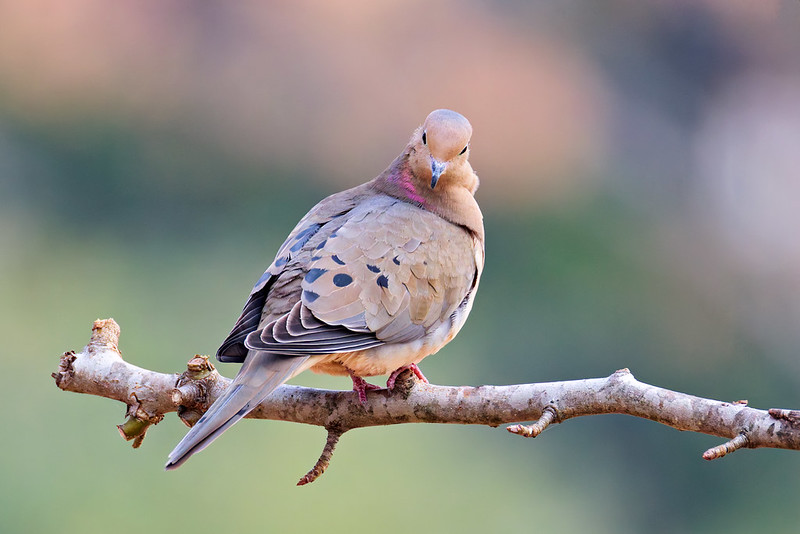
I photographed this Mourning Dove in my yard here in Arkansas. From my deck, I was able to catch a flash of iridescent color on the bird’s neck that really stood out in these two photos.

Mourning Dove Iridescent Color in Soft Light
Mourning Doves have a gentle look, but their plumage can be more colorful than it first appears. In the right light, the feathers on the neck can show a soft pink to magenta shimmer. That color can seem to come and go with even a slight change in angle, which is exactly what made these moments worth photographing. Mourning Doves are also known for their slim shape, small head, and long pointed tail, all of which show well in these images.
What I like about these photos is how the iridescent patch does not overpower the bird. It is subtle. You have to look for it. In the first photo, the color is there but restrained. In the second photo, it catches the light better and becomes a stronger part of the scene. That soft flash of color is easy to miss in the yard unless the bird turns just right.
Mourning Doves are common birds across much of North America, and they often perch in open spots or forage on the ground. Because they are so familiar, small details like this iridescent color can get overlooked. That is one reason I enjoy photographing everyday backyard birds. A common bird can still surprise me.
Photography Notes
I made these photos from my deck using a bean bag on the rail for support. That setup works well for this kind of backyard bird photography. It gives me a stable rest, and it lets me stay in a natural position while waiting for a bird to land where the background looks clean.
Both photos were made with my Canon EOS R5 Mark II and the Canon RF 200–800mm f/6.3–9 IS USM at 800mm. That long focal length helped me fill the frame without pushing too close to the bird.
For the first photo, my settings were f/9, 1/800 second, ISO 4000. For the second photo, my settings were f/10, 1/1250 second, ISO 5000. Exposure compensation was set to 0 for both shots.
The first image shows the dove in a clean side profile. I like it because it shows the full shape of the bird and the elegant line of the tail. The second image is the one that really sells the story, though. The bird’s slight turn toward me catches more of that pink iridescent color on the neck, and that makes the detail easier to see.
High ISO was part of the tradeoff here, but it made sense. I would rather keep enough shutter speed for a sharp bird than chase a lower ISO and lose detail. The smooth background also helps the dove stand out, which keeps attention on the subtle color.
Why Mourning Dove Iridescent Feathers Stand Out
This Mourning Dove reminded me that even one of the most familiar birds in my yard can show something special. In the right light, a bird that looks plain from a distance can reveal a soft, beautiful glow.
That is one reason I keep watching the birds in my yard. There is always a chance that a common moment will turn into something worth a closer look.
I have also written before about the daily visits of Mourning Doves in my Arkansas yard.