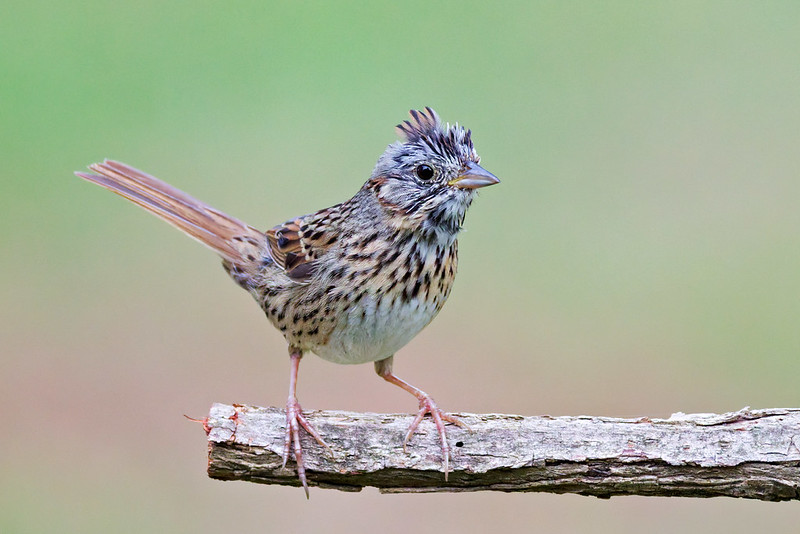
I knew right away that this was not one of the usual sparrows in my yard. The bird looked odd at first, and I could not place it. After I sent the photos to my friend Mia (On The Wing Photography), she told me it was a Lincoln’s Sparrow going through a molt.
Wildlife Notes
Seeing a Lincoln’s Sparrow in my Arkansas yard caught me off guard. I had photographed this species once before at Sequoyah National Wildlife Refuge in Oklahoma in 2023, but never here at home.
Lincoln’s Sparrows can be easy to overlook. They are small, quiet, and often stay low in cover. This bird stood out once I got a good look at it. The fine streaking across the chest, the buffy tones in the face, and the neat, delicate look all pointed in that direction.
What threw me off was the molt. The feathers on the head looked rough and uneven, which made the bird look a little scruffy. That can make identification harder at first glance. In this case, it did for me. I simply did not know what I was looking at until I asked for help.
Early April fits well for a migrant stopping through. Lincoln’s Sparrows often pass quietly through brushy habitat, field edges, and sheltered spots during migration. A backyard feeder is not where I expected to find one, which made this visitor even more interesting.
Lincoln’s Sparrow Identification in the Yard
One thing I like about this photo is how clearly it shows the bird’s fine pattern. The breast streaking is crisp, but not heavy or blotchy. The face looks soft and buffy, and the overall shape is slim and neat.
That combination helped separate it from the more common sparrows I usually see in the yard. The molt made the head look messy, but the rest of the bird still carried the field marks I needed once I slowed down and studied the image.
Moments like this are a good reminder that not every bird shows up in perfect condition. Some arrive worn, molting, or just plain confusing. That is part of what makes bird photography fun. Sometimes the photo helps solve the mystery after the moment has passed.
Photography Notes
This bird gave me a clean side view on a natural-looking perch, which helped a lot. The soft background kept the attention on the bird, and the deck rail setup let me stay steady without making too much movement.
I used a bean bag draped over the deck rail for support. That gave me a stable platform for a long lens and helped me hold the framing while the bird paused.
The light was good enough to freeze the pose, but the ISO had to climb to keep the shutter speed where I wanted it. Even so, the detail held up well, especially around the face and breast.
Camera Settings:
- Camera: Canon EOS R5 Mark II
- Lens: Canon RF 200-800mm F6.3-9 IS USM
- Focal length: 800 mm
- Aperture: f/10
- Shutter speed: 1/1000
- ISO: 6400
- Exposure compensation: +1/3
- Support: Bean bag draped over deck rail
- Date and time: April 03, 2026, 09:05 A.M.
Closing
I am glad I stopped and looked closer at this bird instead of writing it off as just another sparrow. It turned into a rare backyard sighting for me, and one I would have missed without a little help from a friend.
That is one reason I enjoy photographing birds at home as much as I do in the field. You never know when something unexpected will drop in.
Good catch, Steve,
I had one stop by my yard here in Oklahoma last year – the first of its kind I had ever seen. Really pretty sparrow.
Hopefully, both of us will have more show up!