I ordered a new hummingbird feeder for my yard and hadn’t even finished hanging it when a Ruby-throated Hummingbird showed up. I grabbed my camera and managed one clean frame of the bird in mid-flight. It was pure timing.
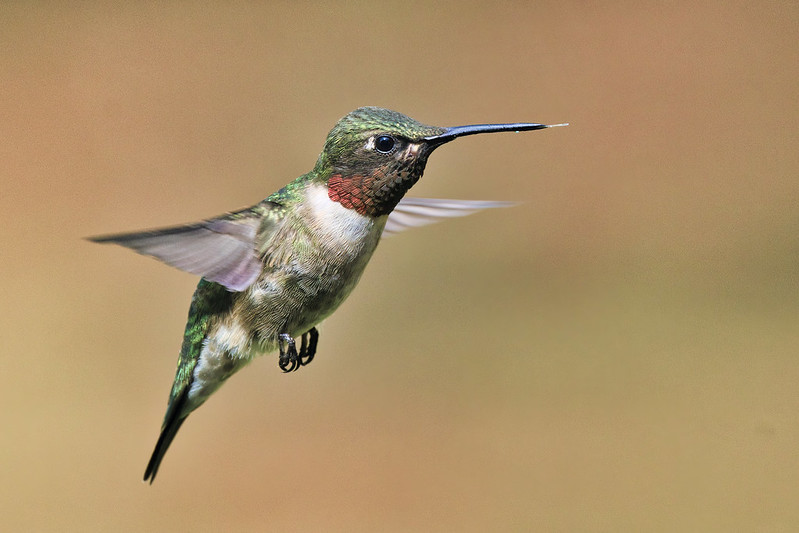
The Ruby-throated Hummingbird Feeder Visit I Almost Missed
The bird appeared before the feeder was fully in place. I rushed to get it hung, then grabbed my camera and fired one shot as the hummingbird hovered nearby. Moments like that don’t wait around. You move fast or you miss them.
Ruby-throated Hummingbirds are the only hummingbird species that breeds in eastern North America. They can hover in place and fly backward, two abilities that set them apart from nearly every other bird you’ll encounter in Arkansas. Their wingspan runs about 4 inches, and they rank among the smallest birds on the continent.
What April in Arkansas Tells You About Spring Arrivals
This encounter happened on April 29, 2023, in Lavaca, Arkansas, at 11:03 in the morning. That timing fits what you’d expect. Ruby-throated Hummingbirds spend the winter in Central America, then push north each spring to breed across the eastern United States and Canada.
The migration includes one of the more remarkable legs in North American bird travel. These birds can fly non-stop across the Gulf of Mexico for up to 18 to 20 hours, covering more than 500 miles over open water. By late April in Arkansas, the first birds of the season have usually arrived and are actively searching for food.
If you want to bring them in, set up a feeder with one part white granulated sugar to four parts water. Skip the honey. It can grow mold and bacteria that harm hummingbirds. Keep the feeder clean and the nectar fresh, and you may not have long to wait.
Freezing the Wings at 1/2000th of a Second
A hummingbird’s wings beat roughly 50 times per second. Anything slower than about 1/1000 will blur them. I was shooting at 1/2000 on this one, which gave me a clean freeze on the wings.
I used the Canon EOS R7 with the Canon RF 100-500mm f/4.5-7.1 L IS USM pulled out to 500mm. The midmorning light at 11 AM was bright and fairly direct. Running ISO 2500 at f/8 gave me the exposure I needed without losing detail on the bird.
- Camera: Canon EOS R7
- Lens: Canon RF 100-500mm f/4.5-7.1 L IS USM
- Focal Length: 500mm
- Aperture: f/8
- Shutter Speed: 1/2000
- ISO: 2500 (Auto)
Getting a usable frame in a situation like this comes down to reacting before you’re ready. For more on the approach I use at the feeder, see my post on Photographing Hummingbirds in Flight at My Feeder.
That morning in Lavaca was a good reminder to keep a camera within reach whenever the feeders are up. Sometimes the bird finds you before you’ve started looking.