For a couple of weeks I kept catching quick glimpses of a bird moving through my yard. I could tell she was something different, but she never sat still long enough for a good look. Then one morning she landed in one of my oak trees and I finally got my shot.
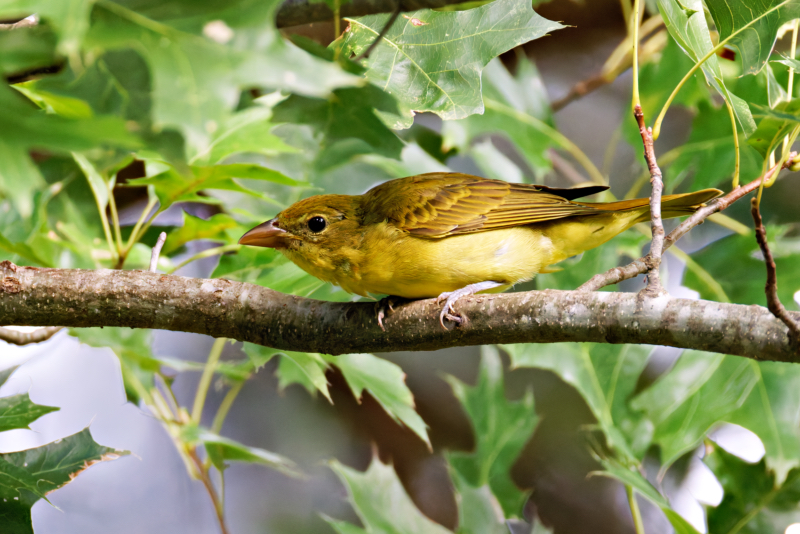
Wildlife Notes: Identifying an Immature Female Summer Tanager
Immature female Summer Tanagers carry a soft yellowish-orange color across most of the body, with greenish tones on the wings and upper-parts. There is no bright red anywhere, which is what makes them easy to overlook or misidentify. Some people confuse them with female Scarlet Tanagers, but the Summer Tanager tends to have a more consistent, warm yellow-orange tone and a noticeably thicker, pale bill. That bill is one of the best field marks to lock onto. I reached out to Mia McPherson to confirm the ID, and I would encourage anyone unsure about a tanager to do the same. A second set of experienced eyes helps a lot.
Habitat, Behavior, and Diet
In Arkansas, Summer Tanagers favor open deciduous woods, especially areas with oaks and hickories. My yard backs up to that kind of cover, which is probably why she kept coming back. She moved slowly and deliberately through the mid to upper canopy, the way tanagers do when they are searching for insects. Now and then she would dart out from a branch to snag something in the air. Summer Tanagers are well known for eating bees and wasps, and they have a habit of rubbing the stingers off before swallowing them. They also take beetles, cicadas, caterpillars, and other insects. Outside of breeding season, fruit and berries round out the diet.
Migration Timing
This bird showed up in mid-August, which fits the calendar. Summer Tanagers arrive in Arkansas around mid-April to early May. By late summer and into fall they start moving south toward wintering grounds in Mexico and Central America. They migrate at night, often crossing the Gulf of Mexico in a single overnight flight. Seeing one in the yard in August is a reminder that fall migration is already underway, even when the heat makes it feel like summer has no plans to end.
Photography Notes: Shooting from the Deck Rail
I set up on my deck using a bean bag draped over the rail. That gave me a stable platform without the noise or movement of a tripod setup, and it kept me low enough to avoid spooking her. She was perched in the oak at a distance that called for the long end of the lens, so I stayed at 800mm the whole time.
Gear and Camera Settings
I was shooting with the Canon EOS R5 paired with the Canon RF 200-800mm F6.3-9 IS USM. At 800mm the maximum aperture locks at f/9, so there was no option to open up. The bird was in open shade and the light was softer than ideal, which is why ISO climbed to 16,000. I pushed exposure compensation to +2/3 to keep from underexposing the subject, and shutter speed sat at 1/800 second, fast enough to freeze a perched bird. ISO 16,000 sounds alarming on paper, but the R5 handles high-ISO files well and noise reduction in post cleaned things up nicely. The final image came out sharp and smooth. If the light had been better I would have pulled ISO down, but the yard does not always cooperate and this time the camera held up its end of the bargain.
Camera Settings
- Camera: Canon EOS R5
- Lens: Canon RF 200-800mm F6.3-9 IS USM
- Focal Length: 800mm
- Aperture: f/9
- Shutter Speed: 1/800 sec
- ISO: 16,000
- Exposure Compensation: +2/3
- Support: Bean bag on deck rail
Closing
Watching this immature female Summer Tanager move through the oaks reminded me why I spend so much time in the yard with a camera. You do not always have to travel far to find something worth photographing. Sometimes patience and a good bean bag are all it takes. If you are seeing something similar in your Arkansas yard this fall, keep watching. It might just land in the right spot.