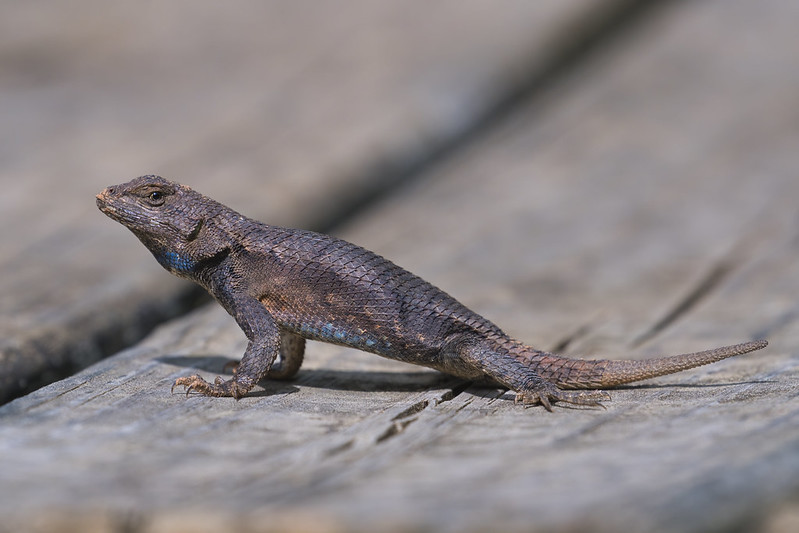
Over the years, I’ve been fortunate enough to spend many summers photographing reptiles in Arkansas and Oklahoma. In particular, I’ve become fascinated by documenting lizards and skinks that have regenerated their tails after injury or predation attempts. This incredible ability to regrow a lost tail has evolved in many lizard and skink species as an effective survival adaptation. By studying numerous individuals over multiple seasons at sites like the Sequoyah National Wildlife Refuge in Oklahoma, I’ve been able to capture photos of different stages of the tail regrowth process.

As some of you may know, many lizard and skink species have evolved the ability to autotomize, or self-amputate, their tails. When grabbed by a predator, the tail will actually detach from the body so that the lizard or skink can make its escape. But these resourceful reptiles don’t just lose their tails forever, they can regenerate or regrow them!
Just days after losing their tails, small nubs are already visible on the lizards’ behinds. Over the next few weeks, these nubs extend into pointy, elongated new tails, covered in smooth skin instead of scales. It may take a couple months for the new tail to reach full length again.
So how did lizards and skinks come to develop this ingenious trick?
A detached tail continues to wriggle vigorously after separation, distracting the predator while the lizard or skink scurries away. Some lizards will even detach their tails when grabbed by the tip, they can afford to lose a small portion of their tails while ensuring their ultimate survival. Having a detachable tail gives lizards and skinks a better chance of living another day to breed and pass on their genes.

The regenerated tail often looks slightly different than the original, it tends to be stiffer, shorter, and may be a different color. But despite these small differences, it serves its purpose well in providing balance and remaining a handy predator distraction device.
I hope you’ve enjoyed this insider’s look at lizard and skink tails.
Here is an old blog post I wrote about a Lizard Growing New Tail
Image Information: First Image
- Date: 5/26/23
- Time: 8:55 AM
- Camera: Canon EOS R5
- Lens: Canon RF 100-500 mm F4.5-7.1 L IS USM
- ISO: 500
- Aperture: 8
- Shutter: 1/800
- Exp. Comp.: +0.7
- Program: Manual
Note: Someone asked a great question: How many times can they grow their tails? Here is what I discovered:
Many lizards can regrow a lost tail once, but the exact limit varies by species and by where the original tail breaks.
The key detail is that the replacement tail is usually supported by a cartilage rod rather than rebuilt vertebrae, so it generally lacks the specialized break points that let the original tail detach. If a lizard first loses only the tip, it may still later shed another remaining section of its original tail and regrow again. In practice, a lizard may regenerate a tail a few times over its lifetime, but each loss tends to occur nearer the body and the resulting tail is usually shorter or less flexible.
Not every lizard can do this, many species have limited or no tail-regeneration ability.
Steve, this is a wonderful, informative post and I love the images you used to illustrate the tail regeneration process in lizards and skinks. Excellent.
Thanks my friend!
Now I need to know if this is a one hit wonder or if they can grow a third or forth. I always know this was a possibility, but never gave it much thought before
Thanks for the awesome question and after some research I was able to add the answer to the end of my blog post.